
L.A.’s Most Misunderstood Neighborhood Was No Accident
From railroad boomtown to deliberate “containment zone,” a century of civic decisions shaped Skid Row — a community now facing gentrification, a mayoral race and the 2028 Olympics.

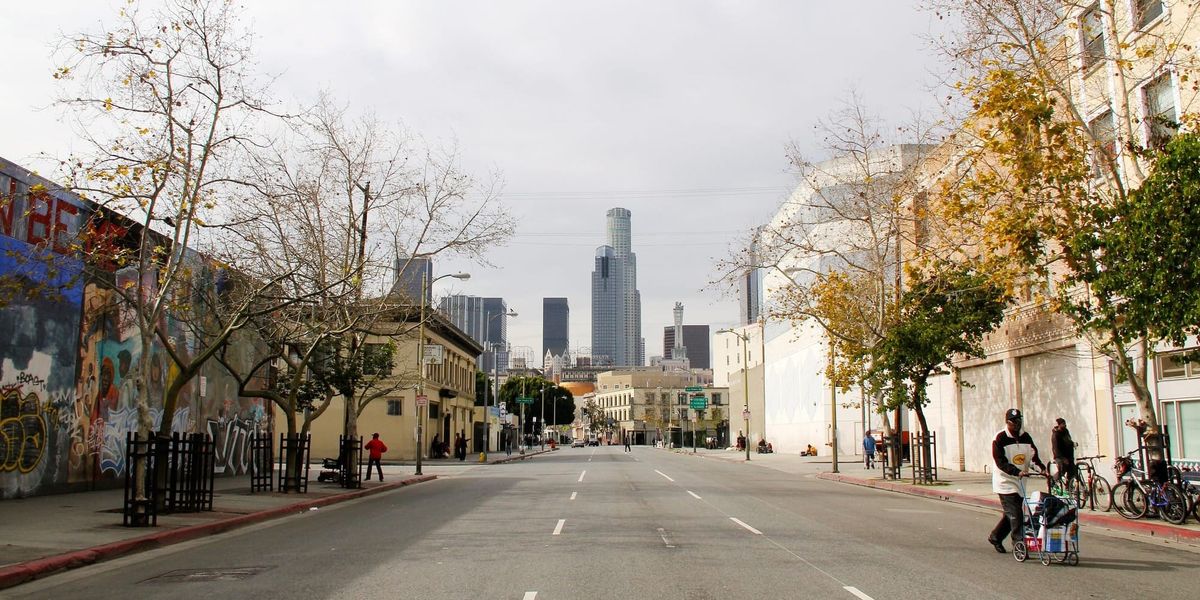
LOS ANGELES — Instead of concrete and asphalt, picture Los Angeles with rows of fruit trees. In the 19th century, one didn’t have to imagine it. Citrus groves could be found all over the city, including near the notorious downtown district now known as Skid Row. In fact, that area was once central to L.A.’s agricultural economy, connecting the river, the railroad and a burgeoning downtown.
So, how did Skid Row become a symbol of urban blight — a neighborhood politicians use to point fingers at each other, with one recent mayoral candidate outlining a plan to jail or relocate its unhoused inhabitants?
National interest in the roughly 50-block zone — bounded by Third and Seventh and Main and Alameda streets — is intensifying due to the 2026 L.A. mayoral race and the upcoming 2028 Olympics. But the current state of Skid Row, which has the highest concentration of unhoused individuals in Los Angeles County, can’t be attributed to a single policy or political administration. Rather, civic decisions by railroad companies, city planners, redevelopment agencies and generations of politicians shaped the neighborhood that exists today.
“This is systemic and structural,” said Catherine Gudis, a scholar-in-residence at the Skid Row History Museum and Archive. “It’s been going on for over 100 years.”
Even as homeless encampments have fanned out across Los Angeles, Skid Row continues to serve as a metaphorical stand-in for all the city’s unhoused population — one that has grown by 3.4 percent, bringing the number of Angelenos experiencing homelessness to 45,194, according to the 2026 Greater Los Angeles Homeless Count.
Throughout its history, those familiar with the area say, Skid Row has been more complicated than the dominant narratives suggest. It shifted from an area of economic promise in the 1800s to a low-income housing zone in the 1900s — only to become a political lightning rod in the 2020s. Arguably L.A.’s most misunderstood neighborhood, Skid Row is a community filled with activism, resilience and creativity.
As Tom Grode, a Skid Row creative and advocate, put it: “Does it have some unique problems? Yes. Does it need more assistance than most neighborhoods? Yes. But that does not invalidate it as a neighborhood.”
How did Skid Row begin — and get its notorious nickname?
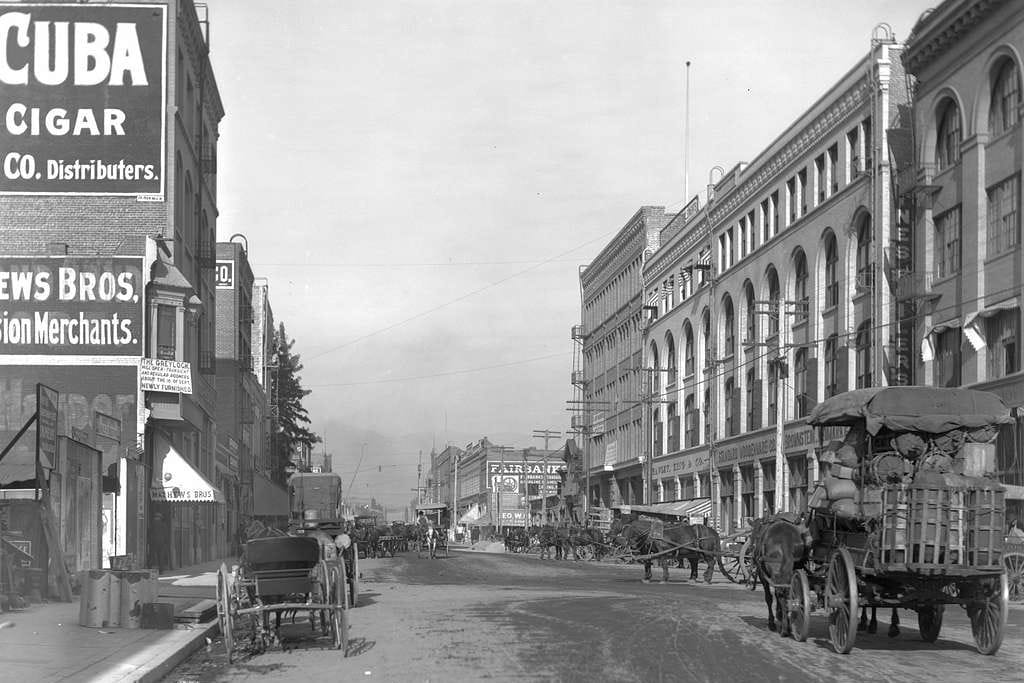
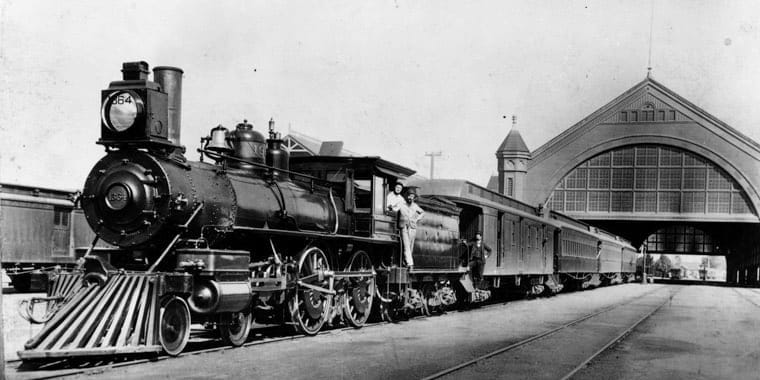
Skid Row dates back to the completion of tracks linking Los Angeles to the transcontinental rail network in 1876. The railroad companies and land promoters accumulating in the region after the Gold Rush inspired thousands to migrate west, according to Henry Michael Apodaca, media archivist at the Skid Row History Museum and Archive. The museum, on Broadway, still sports a sign reading “Antique Glamour” from a previous tenant — a quinceañera dress boutique.
On an August afternoon, the museum’s archives were packed with decades-old photos, recordings and documents. One wall featured a giant timeline chronicling the history of Skid Row housing — a subject Apodaca discussed at length.
“You have this railroad,” he began. “It finishes near the historic area of Skid Row, but what's coming on the railroad are itinerant workers, single men ... coming to work for a certain period of time, a couple weeks to a couple of months.”
To meet the demand, a new form of short-term housing arose — the single-room-occupancy (SRO) hotel. “To stay in these hotels was extremely cheap, and you rarely saw people going back to where they were coming from,” Apodaca said.
The concentration of single men led the area to develop a reputation for vices like alcoholism, prostitution and gambling. In response, the Christian nonprofit Union Rescue Mission, which opened in 1891, deployed a “gospel wagon” to hit the streets and preach against drunkenness. The wagon marked the start of coordinated faith-based outreach in the neighborhood. Religious charitable organizations such as the Salvation Army opened a facility there in 1892, with the Midnight Mission following in 1914.
The area soon accumulated nicknames including “Hell’s Half Acre,” “Hobo’s Corner” and “The Nickel.” The name that stuck — “Skid Row” — refers to the “skid roads” where workers used to drag timber in the Pacific Northwest. Eventually, the downhill slide of logs along those tracks led to the metaphor “on the skids” to describe people and places experiencing a rapid decline.
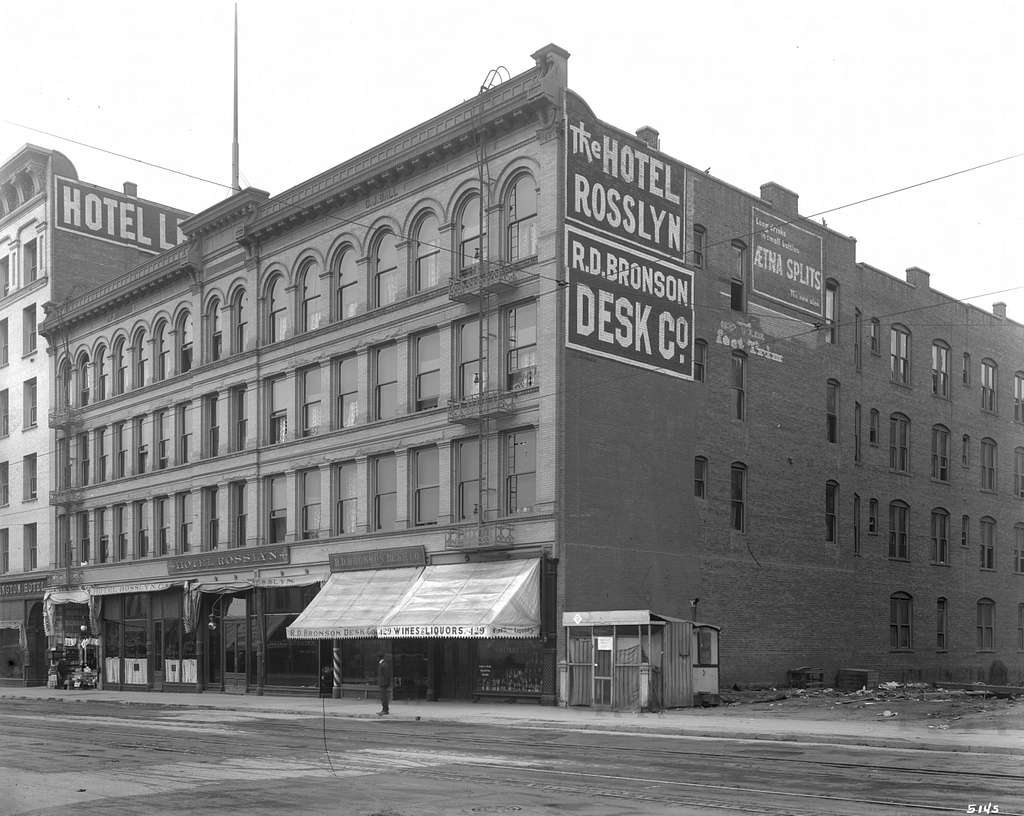
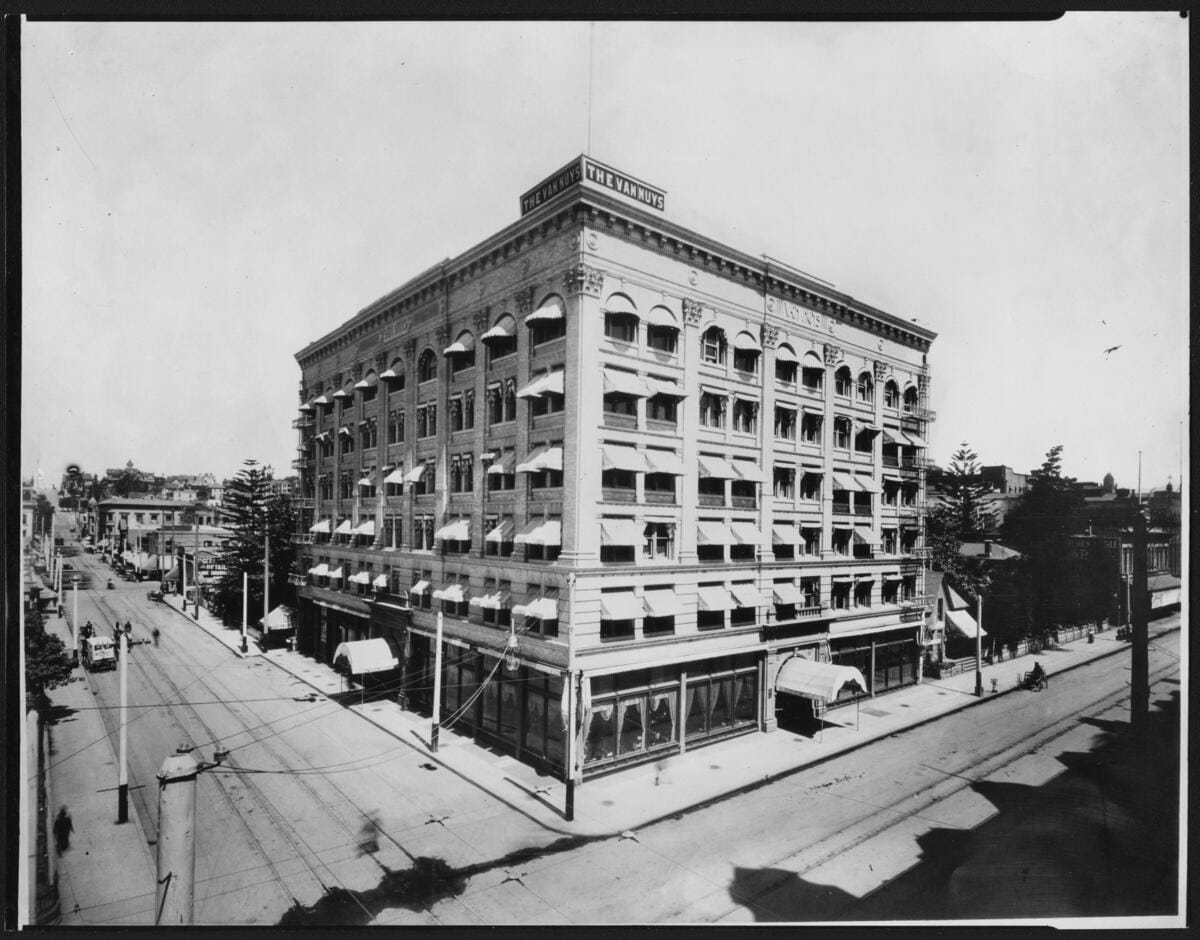
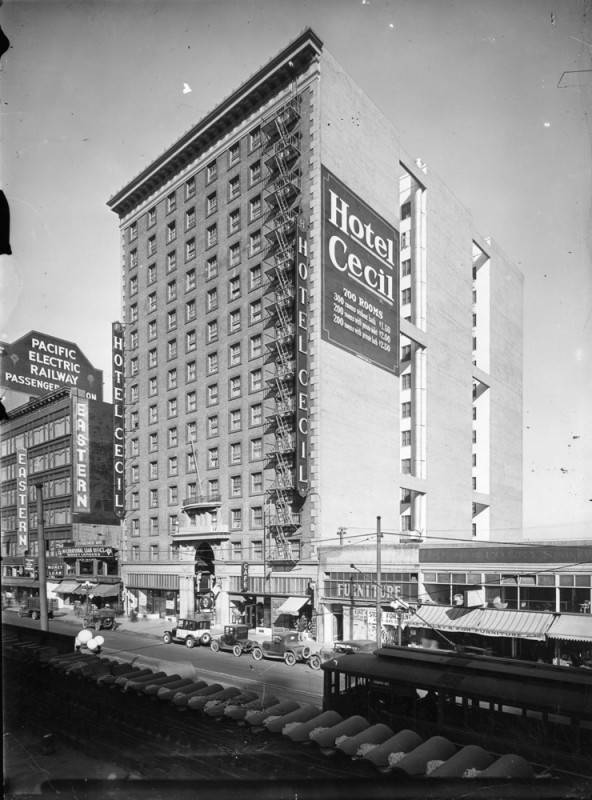
Once grand buildings built in the early 1900s, many downtown hotels still serve Skid Row residents today. Pictured: The Hotel Rosslyn (circa 1905), The Van Nuys, later renamed the Barclay Hotel (circa 1902) and the Hotel Cecil (circa 1925). Photo courtesy of the California Historical Society / University of Southern California Libraries and the Los Angeles Public Library.
Was Skid Row designed to fail — or to contain the poor?
As L.A.’s Skid Row took shape in the early 1900s, the city’s population exploded, growing from 11,183 people in 1880 to 576,673 in 1920. Freeways gave residents the means to commute to work, prompting affluent Angelenos to leave downtown for nearby suburbs. “What remained were these disinvested-in swaths of housing,” said Gudis, who is also a professor of history at the University of California, Riverside.
After World War II, city leaders used zoning and code enforcement to target these neglected neighborhoods for redevelopment. In 1948, Los Angeles established its Community Redevelopment Agency, enabling the city to remake its downtown. The agency eliminated much of the affordable residential housing in Bunker Hill, in the northwest corner of downtown, to clear the way for new office towers and civic buildings.
“They put in a skyline right there, right in the middle of it,” Apodaca said. “They wanted to do the same thing in Skid Row.” This model of clearing “urban blight” to build something new would become a strategy repeated by civic leaders for decades.
By 1972, city planners proposed a plan widely known as the Silver Book to declare most of downtown an urban renewal area. In Skid Row, Apodaca said, they aimed to level cheap hotels to create “a bustling economic hub” — essentially, another Bunker Hill. The officials reasoned that poverty in the area would disappear once the low-cost lodging did. But, Apodaca added, “They didn't give a plan for how that was going to happen.”
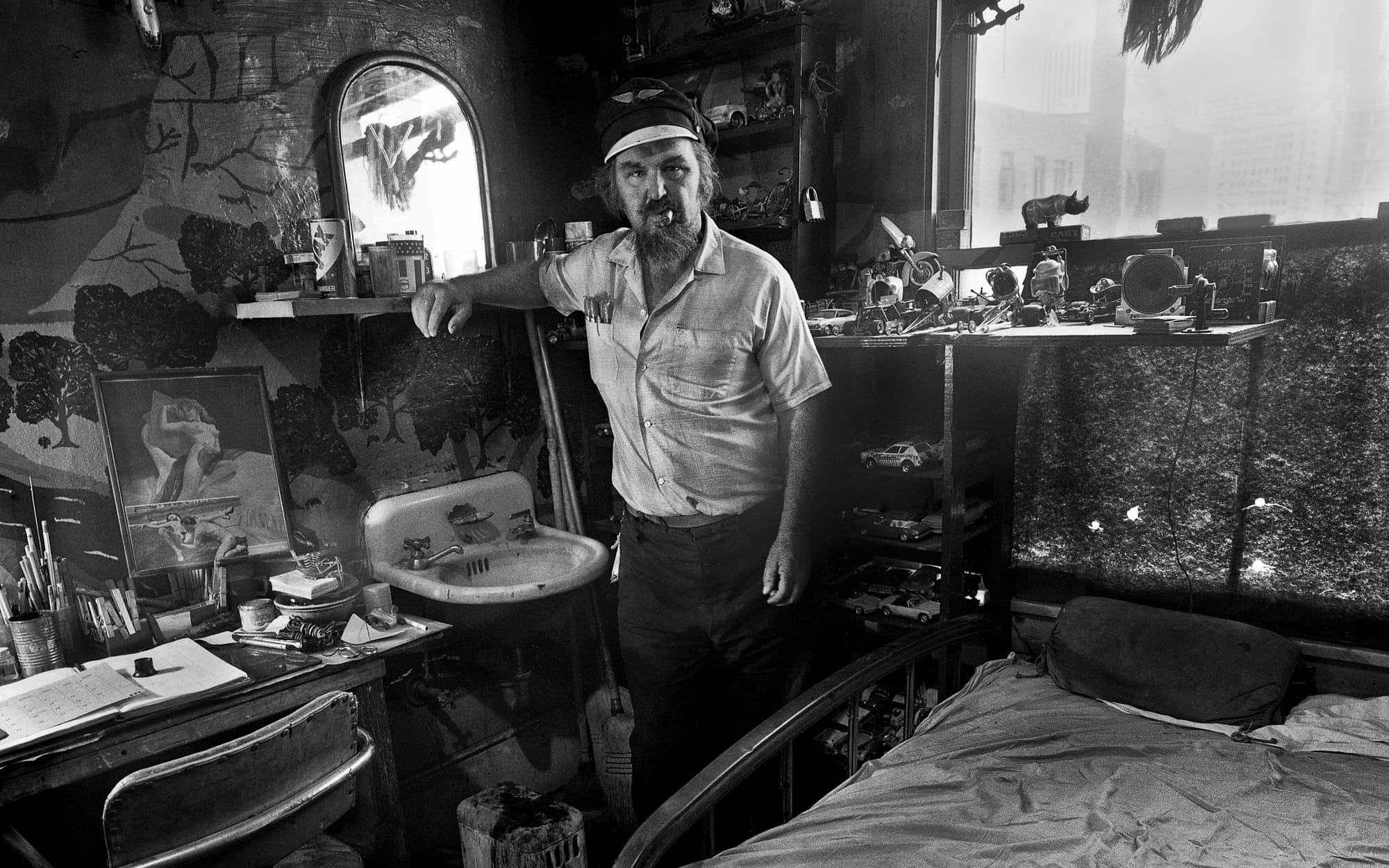
Skid Row organizers responded with the Blue Book, a 1976 proposal that influenced the city to retain housing in the community. The activists argued for preserving hotels and concentrating services — shelters, legal aid, medical and mental health care — within a defined boundary.
“The idea was to try to contain the spread [of poverty] that was going to affect these redeveloped areas by concentrating tax money, tax increment financing and other things — to not only build those shiny towers in Bunker Hill and in parts of downtown but then to also invest in the existing resources within that containment zone,” said Gudis, who has written extensively about this period.
City officials often framed the plan as an effort to “contain poverty” within Skid Row. The real goal, however, was to “contain” resources in one neighborhood for vulnerable residents citywide, Apodaca said. Since Skid Row emerged as the neighborhood with a host of social services, it became a magnet for the economically disadvantaged.
“That's how downtown Skid Row grows in terms of the density of its population and its boundaries,” Gudis said.
What happened when the 1984 Summer Olympics came to town?
As federal policies shifted, social problems in Skid Row escalated in the 1980s.
“The blight, the excessive number of people on the streets, was occurring in the late ’70s going into the ’80s, especially when Reagan took office,” Apodaca said. “Jobs get exported, people lose money … and consequently become homeless and on the street.”
The crack cocaine epidemic and a decline in funding for affordable housing saw homeless encampments multiply in the neighborhood. Ahead of the 1984 Summer Olympics in Los Angeles, law enforcement aggressively enforced anti-camping laws such as Municipal Code 41.18 in Skid Row.
The city also implemented “Greyhound therapy,” Apodaca said. “They'll get everyone here and bus you out of the area, bus you to the Valley, bus you to the Inland Empire, out of sight.”
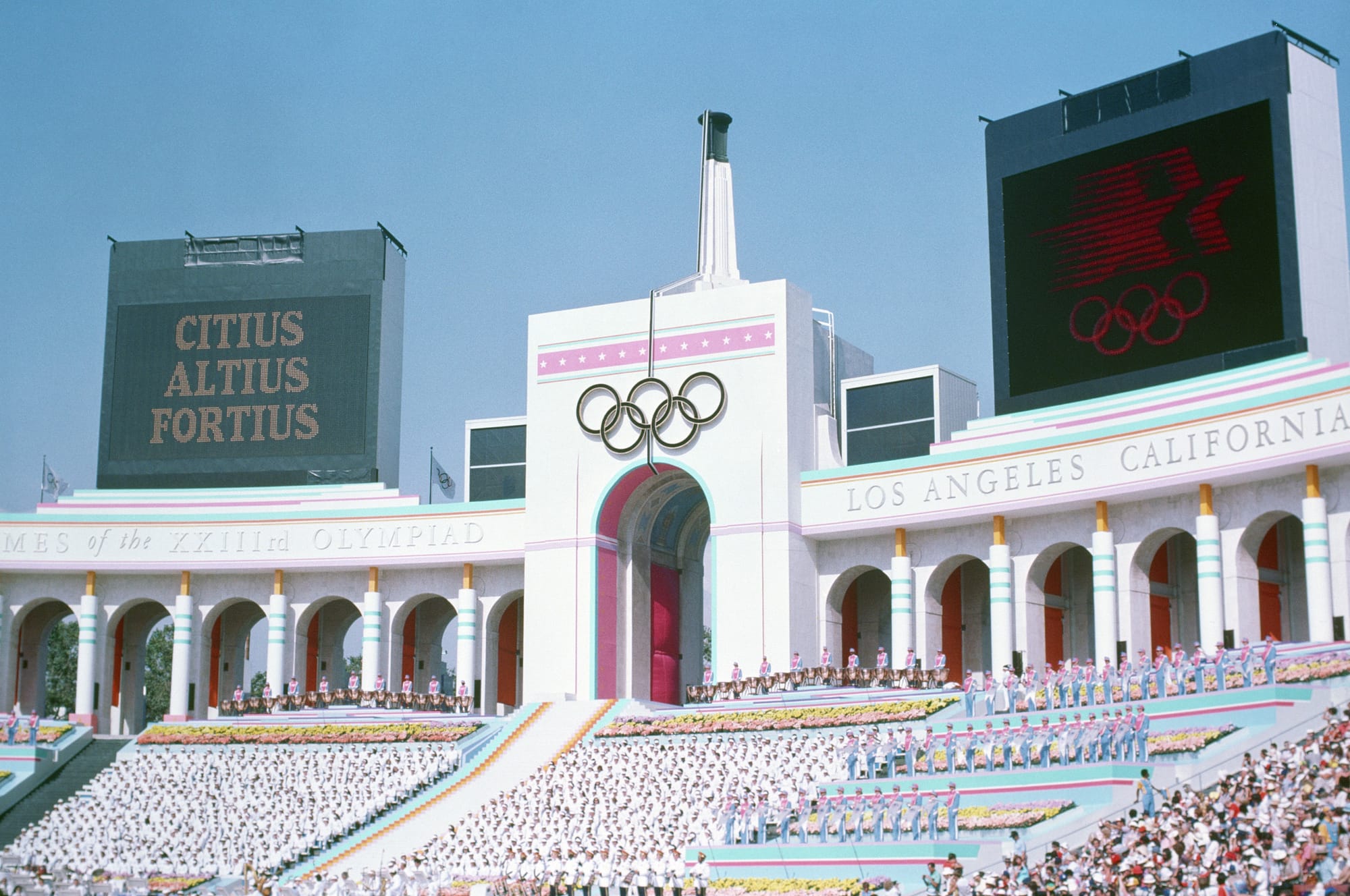
Mass sweeps have lasting effects for unhoused individuals. “Every time you do a sweep to remove people, they lose all of what a caseworker might have worked with them to achieve over years: a license, a proof of disability, any form of ID, their medications, the things you need if you're going to get housing or health care,” Gudis said.
Motivated by the 1984 sweeps, artist John Malpede founded the Los Angeles Poverty Department — the nation's first theater company of housing-insecure performers. They hosted workshops and documentary-style performances, and their archive ultimately became the Skid Row History Museum, which opened in 2015.
Grode joined the L.A. Poverty Department after moving into the Union Rescue Mission when his finances collapsed in 2013. To date, he has performed in at least a half-dozen productions with the company.
“I think Skid Row is amazing when it comes to arts and culture,” Grode said. “There's actually some really wonderful qualities about it that get ignored because there are these very serious problems.”
The 1980s saw a flurry of organizations open in Skid Row — from the SRO Housing Corporation, founded in 1984 to rehabilitate the neighborhood’s hotels, to the Skid Row Housing Trust, launched in 1989 to offer residential resources to housing-insecure people.
But the decade kicked off with the 1980 opening of the Inner City Law Center to represent Skid Row tenants and unhoused people. The firm sued slumlords over vermin infestations in apartments where families with children resided — cases documented in the Skid Row History Museum's archive.
Single men may have flocked to Skid Row in the late 1800s, but families have belonged to the neighborhood for years. Apodaca described seeing immigrant families arrive at Union Rescue Mission, luggage in hand. Moreover, social services organizations such as Para Los Niños now serve children living in area shelters.
With families, Apodaca said, “there’s an additional need for resources.” Along with housing, they need metro passes, backpacks, free school meals and school clothes.
Whose Skid Row is it anyway?
Conflicting narratives continue to surround Skid Row. Politicians, community organizers, developers and residents all have competing ideas about what’s needed for the neighborhood. That includes what it should be called. In the 2010s, business leaders increasingly used the name “Central City East.” But community groups prefer the older, blunter name, demonstrating their pride in that moniker on the “Skid Row City Limits” mural on San Julian Street.
“What I love about Skid Row is that it's a community of communities that isn't acknowledged as one,” Apodaca said. He pointed to the failed attempts to form a dedicated Skid Row neighborhood council, separate from the downtown council he says is dominated by property interests. “We get absorbed into the downtown neighborhood council,” he said. “Does it represent Skid Row? No.”
Grode fought to form a Skid Row neighborhood council. He said the only legitimate way to characterize the area is as a community. Now 70, he moved away nine years ago after an acquaintance offered him steeply discounted rent three miles west in Koreatown. Still, he visits regularly as an advocate.
"Skid Row is a unique neighborhood within downtown, and downtown is a bunch of unique neighborhoods next to each other,” he said. “That's the way you have to talk about Skid Row."
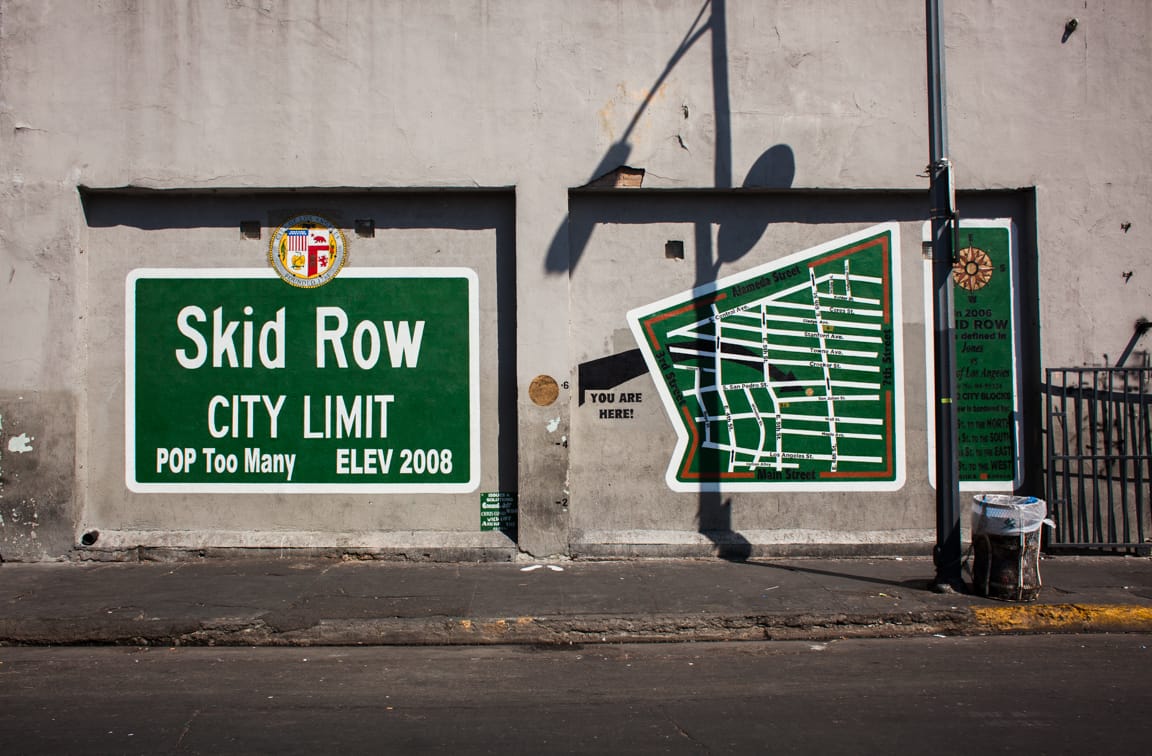
Deeply rooted structural challenges remain for the community. A fractured city-county system in which two governments split responsibility for homelessness, health and social services has compounded the housing affordability crisis.
“We have an incredible disparity in incomes in Los Angeles,” Gudis said.“How is a mayor's term going to address that? It's not feasible.”
During her first mayoral term, Karen Bass has been fiercely criticized for two major issues: her handling of the 2025 Los Angeles wildfires and of the city’s homeless problem.
“Have I solved a problem that's been 35 years old? No,” she said during an appearance on the “Higher Learning” podcast in May. “Did I make very specific inroads by addressing street homelessness with a comprehensive plan for the first time in this city? Yes.”
She traced the city’s homelessness growth to the 1980s and ’90s. In 1990, Bass started the nonprofit Community Coalition to empower residents to counter poverty, crime and substance misuse.
“I started it on 85th and Broadway when we were having 1,000 homicides in L.A.,” she said in May. “The Crips and the Bloods were at their height, and crack cocaine was at its height. That was when homelessness actually switched races and became more African American. Black folk are 9 percent of the population of L.A. We are 30 percent of the people on the streets.”
After her swearing in as mayor in December 2022, Bass quickly made good on a campaign promise to get people indoors — declaring a state of emergency over L.A.'s homelessness crisis.
“With Karen Bass being in office, we have somebody that understands what's going on,” said Crushow Herring III, an artist and activist who began living in Skid Row in 1999 following a series of post-college setbacks.
The 49-year-old was an early leader of the Sidewalk Project, an arts program that began nine years ago to empower people living outdoors. That some politicians have dehumanized Skid Row’s residents, proposing to forcibly remove them, caused Herring to struggle for words.
“This is America, so that doesn't make any sense,” he said. “You don't force anyone against their will."
On the other hand, he praised Karen Bass, calling her “a soldier” for the community. As for her many critics, Herring said, “They just want people off the streets. They don't care how.”
Tents are disappearing. Why are more people sleeping on the ground?
The makeup of Skid Row’s unsheltered population has changed markedly in recent years, according to a multiyear study by research institution the RAND Corporation.
“We're seeing a dramatic decrease in the number of people living in tents and an increase in people ‘sleeping rough’ — a shorthand to say living literally unsheltered without a tent or a vehicle,” said Sarah B. Hunter, a senior behavioral scientist at RAND.
Recreational vehicles in the neighborhood rose from the single digits in September 2021 to nearly 50 in January 2026, according to RAND. Skid Row’s unhoused population grew steadily over the length of the study, averaging annual increases of about 4 percent. Roughly 2,100 people were unsheltered in Skid Row on an average night last year, triple the amount of those in Venice and Hollywood.
In the mid-aughts, the authorities attempted to “clean up” Skid Row by telling people they could either be arrested or enter a shelter, Hunter said. But the American Civil Liberties Union challenged that policy successfully.
Underneath the fights about policy lies a conflict over profit. Gentrification threatens Skid Row, with developers raising rents on renovated buildings at the neighborhood’s outskirts.
“The land is extremely valuable,” Grode said. “But before you can build market-rate housing and get someone to spend $2,500 a month for a one-bedroom apartment, obviously, you have to change the neighborhood. People aren't going to do that at the moment. They'll do it in the Arts District or in Little Tokyo. They're not going to do it in Skid Row."
One of the more contested additions to the neighborhood is the Skid Row Care Campus, a county-funded operation combining services and shelter beds. Launched last year, the Care Campus has drawn criticism due to reports of overdoses and violence nearby.
"One of the things about the Care Campus that is definitely controversial in some circles is the harm reduction philosophy behind it, and so that will attract people who are, you know, actively doing drugs," Grode said. “With drugs comes violence."
The Care Campus is an outgrowth of the Skid Row Action Plan, a 2022 blueprint to expand housing and other services for vulnerable populations. Grode played a key role in the plan, serving on its residents advisory committee and permanent housing work group.
Ensuring its success “boils down to the city and the county getting on the same page and each bringing their resources to the table and putting some solutions together," he said.
The Care Campus also brings to mind an ongoing disagreement over the sequencing of support: Should the city prioritize permanent housing or lean on temporary accommodations instead? Hunter's research recommends permanent housing as the more durable solution but found that up to 45 percent of Skid Row residents her team surveyed are already on a waiting list for it.
“Over 95 percent tell us they want housing if they were offered it,” she said. Bass has argued that permanent housing simply takes too long to build to scale.
But Hunter supports providing care through whatever housing exists — “everything across the continuum, starting at prevention all the way to what we call permanent supportive housing,” she said. She's also cautious about treating unhoused people’s struggles as evidence they don't want help.
“It's very difficult to remain sober in Skid Row. It is very easy to purchase illegal drugs there. Changing your environment can make it a lot easier to change your lifestyle.”
Who gets to decide Skid Row's future?
For all of Skid Row’s challenges, residents and supporters point to resilience and signs of hope. The L.A. Poverty Department remains a vibrant space for artistic expression and performance over 40 years after its founding.
Skid Row’s arts and activism scenes deserve more attention, Apodaca said. “Those attributes don't get the coverage that addiction, transients, hobos, mental illness does. We should think about grabbing attention through positive attributes at the same time.”
Ahead of the 2028 Games, a coalition including the Skid Row History Museum is organizing around efforts such as Skid Row Now & 2040 and NOlympics LA campaign to prevent another wave of displacement for unhoused people.
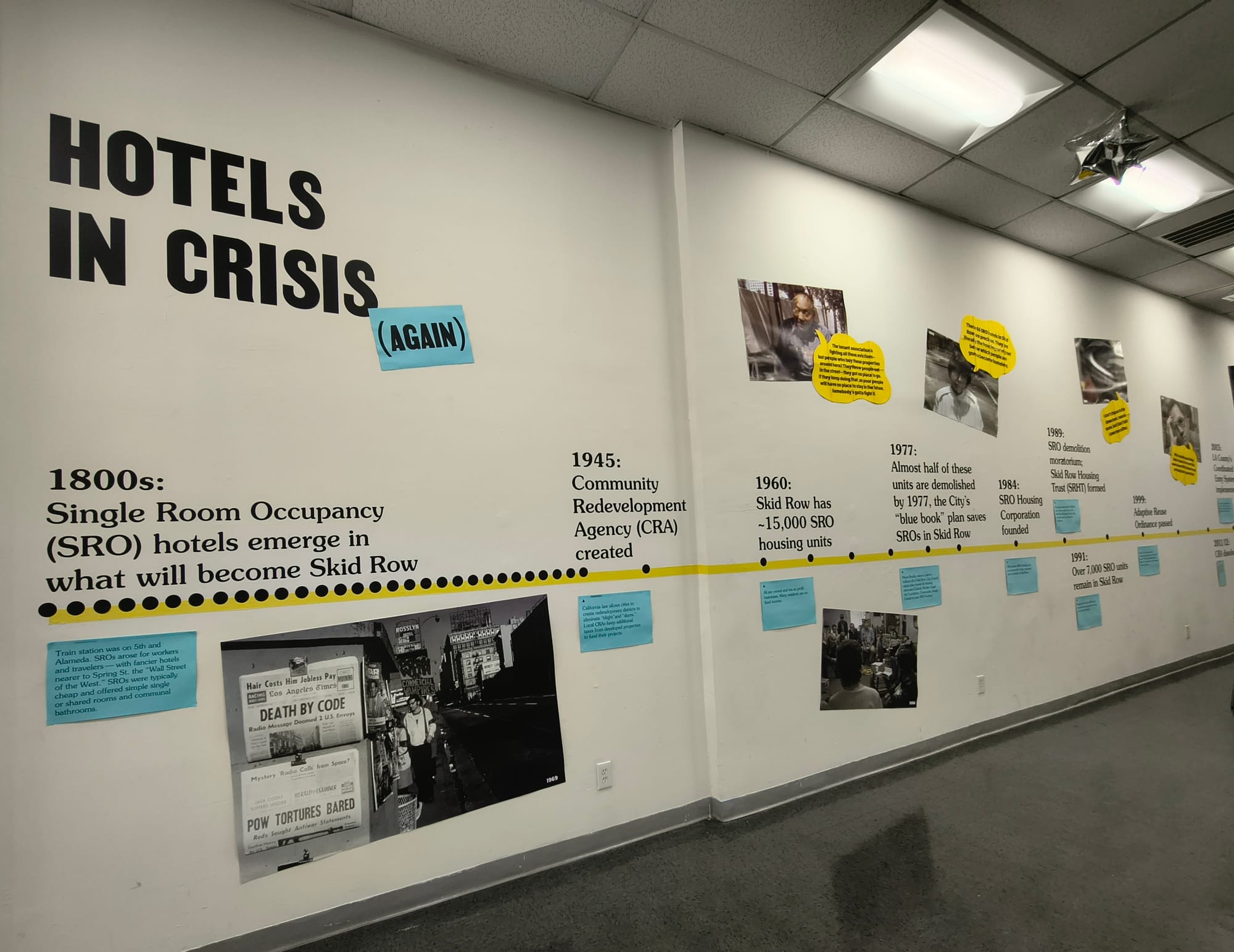
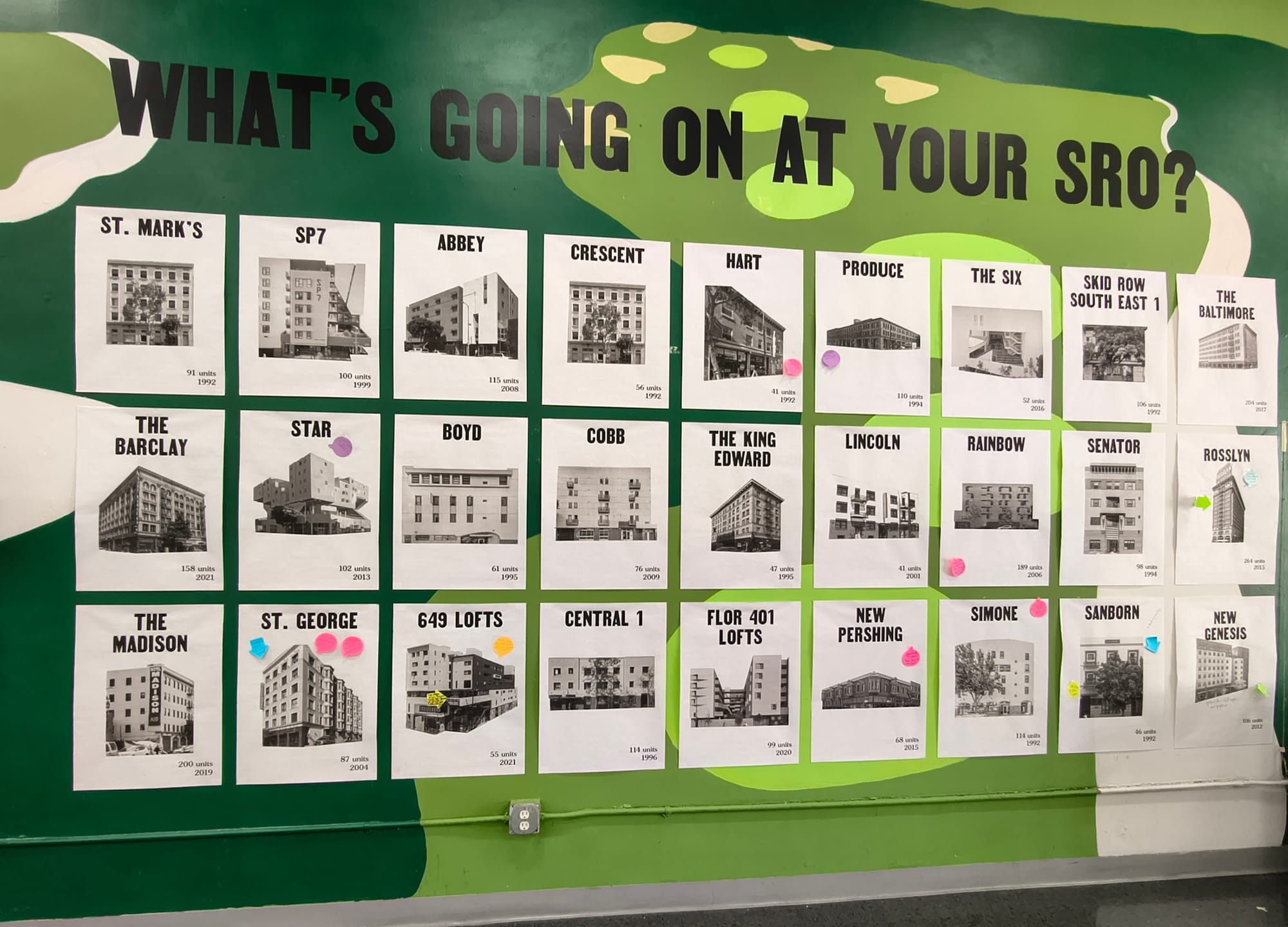
The Skid Row History Museum and Archive’s current exhibit, “Hotels in Crisis (Again),” features a timeline and photo gallery of single room occupancy (SRO) hotels in the area. Photos by Anthony Nittle for The Fault Line News.
Skid Row's next chapter will almost certainly be shaped by decisions made well beyond the neighborhood — a mayoral race, the state housing budget and preparations for the 2028 Games. Whether it is treated as a community or as a problem to be moved out of sight is the same dilemma that has plagued Skid Row for decades.
“It would behoove the city council to always consult with Skid Row leaders, community members, before implementing or even campaigning new programs,” Apodaca said.
Skid Row is everyone’s responsibility, Herring contends, arguing that the public can intervene, but few actually do. “If everybody took the time to help instead of just pointing fingers and running their mouth and looking somewhere else, then this would be over with.”
Herring likens Skid Row to the Blue Heron, a bird known for its keen sight and long neck that lives high up in the treetops. It is the unofficial symbol of the Los Angeles River and a recurring figure in his murals.
“We're all unique like that Blue Heron bird,” he said. “Just unique creatures coming to get resources to survive."
This article — produced by The Fault Line News — is available to republish for free. For republishing inquiries, please contact us.