She Fought to Wear Tribal Regalia at Graduation. Then She Helped Change California Law.
Bella Garcia feared she would be barred from commencement for her eagle feathers, beaded cap and ribbon skirt. Now, graduates statewide can wear their cultural adornments — no permission slips required.


On the same day as her high school graduation, Bella Garcia first took part in another ceremony — one that honored her Indigenous heritage.
In the parking lot of Clovis High School, her uncle lit white sage, bathing her in plumes of pungent, camphorous smoke. Her mother gave her a tribal stole to wear over her graduation gown, and other relatives presented her with a beaded graduation cap. Leather covered the mortarboard, which had white, yellow, red and black trim — the colors of the medicine wheel, a sacred symbol representing the knowledge of the universe.
Until just before commencement, Garcia hadn’t seen the objects her loved ones infused with their “medicine,” or good intentions. One by one, they made sure the items were secure, especially the two eagle feathers on her tassel.
A member of the North Fork Rancheria of Mono Indians of California — a tribe based in the Sierra Nevada foothills just east of the Central Valley — Garcia said graduation marks the first time many Indigenous youth receive eagle feathers. “It's their first huge milestone in their life. It's this constant reminder that you were given it because of everything that you've accomplished up until this point.”
Eagle feathers stable, Garcia headed to graduation wearing moccasins, a ribbon skirt and a dentalia necklace. She’d spent her final years of high school fighting for this moment — the freedom to wear tribal regalia to graduation.
What should have been a celebratory senior year was colored by clashes with administrators over their commencement dress code, one Garcia felt ignored her right to express her cultural identity. But with help from lawyers, lawmakers and a tribal chairman, she won her battle — last year becoming the first Native American student from Clovis Unified School District to walk the stage in an assortment of tribal regalia.
To ensure no one else in California had to work so hard to do so, she advocated successfully for the passage of Assembly Bill 1369. The law lets students wear culturally significant items on graduation day without pre-approval from school officials, a process that has disproportionately affected Indigenous students.
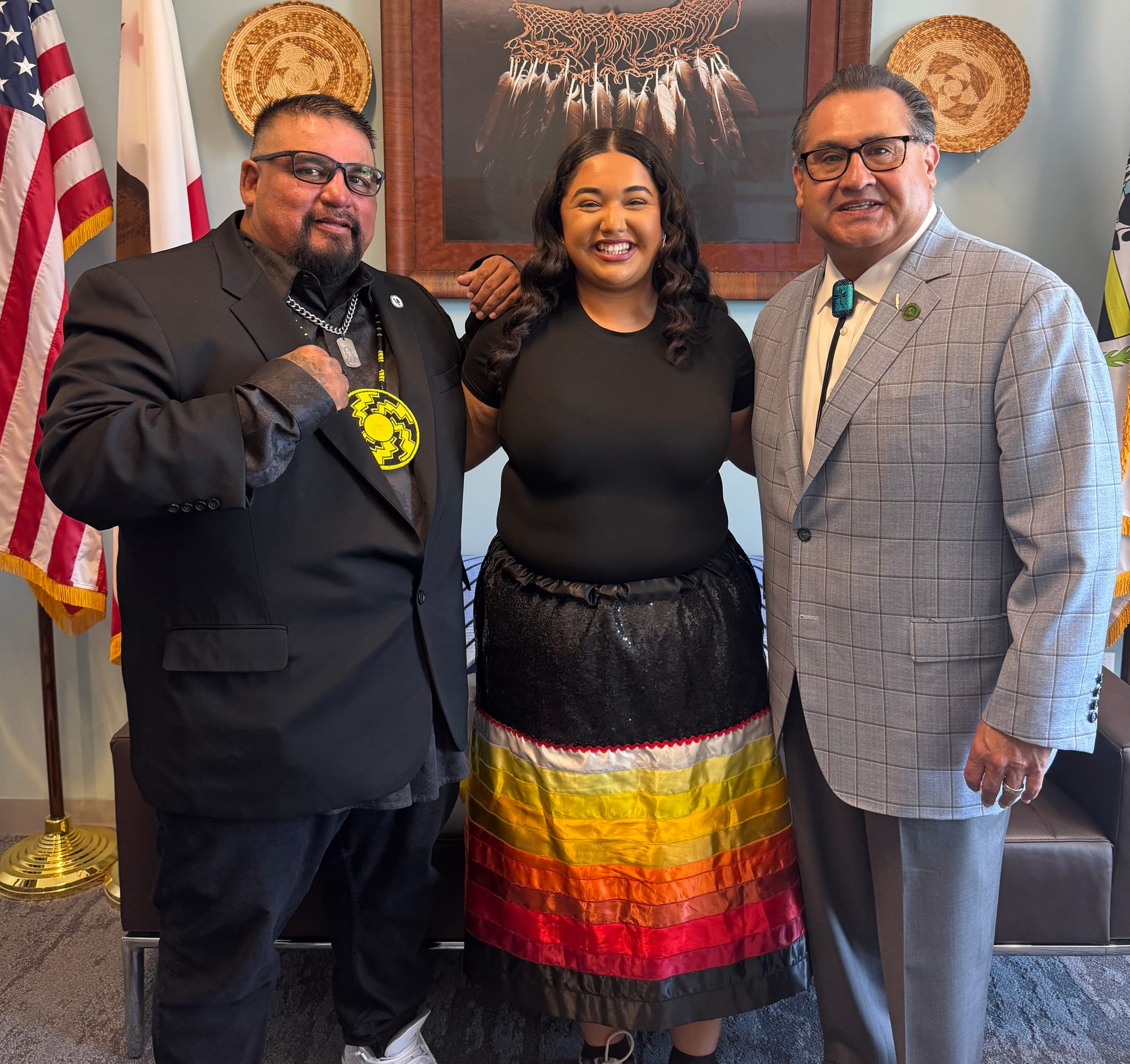
“We can't say enough about Bella because Bella could have just agreed with the administration and not worn regalia, but she decided to make a statement,” said Assemblyman James Ramos, a Democrat from San Bernardino who introduced the bill. “So we supported her, got AB 1369 lobbied through . . . and signed by the governor.”
This year the law took effect, allowing the estimated 454,800 students who graduated from public high schools statewide in May and June to do so unencumbered by school policies that would have targeted them for wearing tribal regalia or ethnic dress.
The law’s impact was clear during the 2026 graduation season, according to Jay Petersen, a senior staff attorney with California Indian Legal Services, the nonprofit law firm that represented Garcia during her ordeal and has served the state’s Indigenous communities since 1967.
“I can say there have been no complaints of: ‘We are being prohibited from wearing what we need to wear.’ None,” he said. “That's huge progress.”

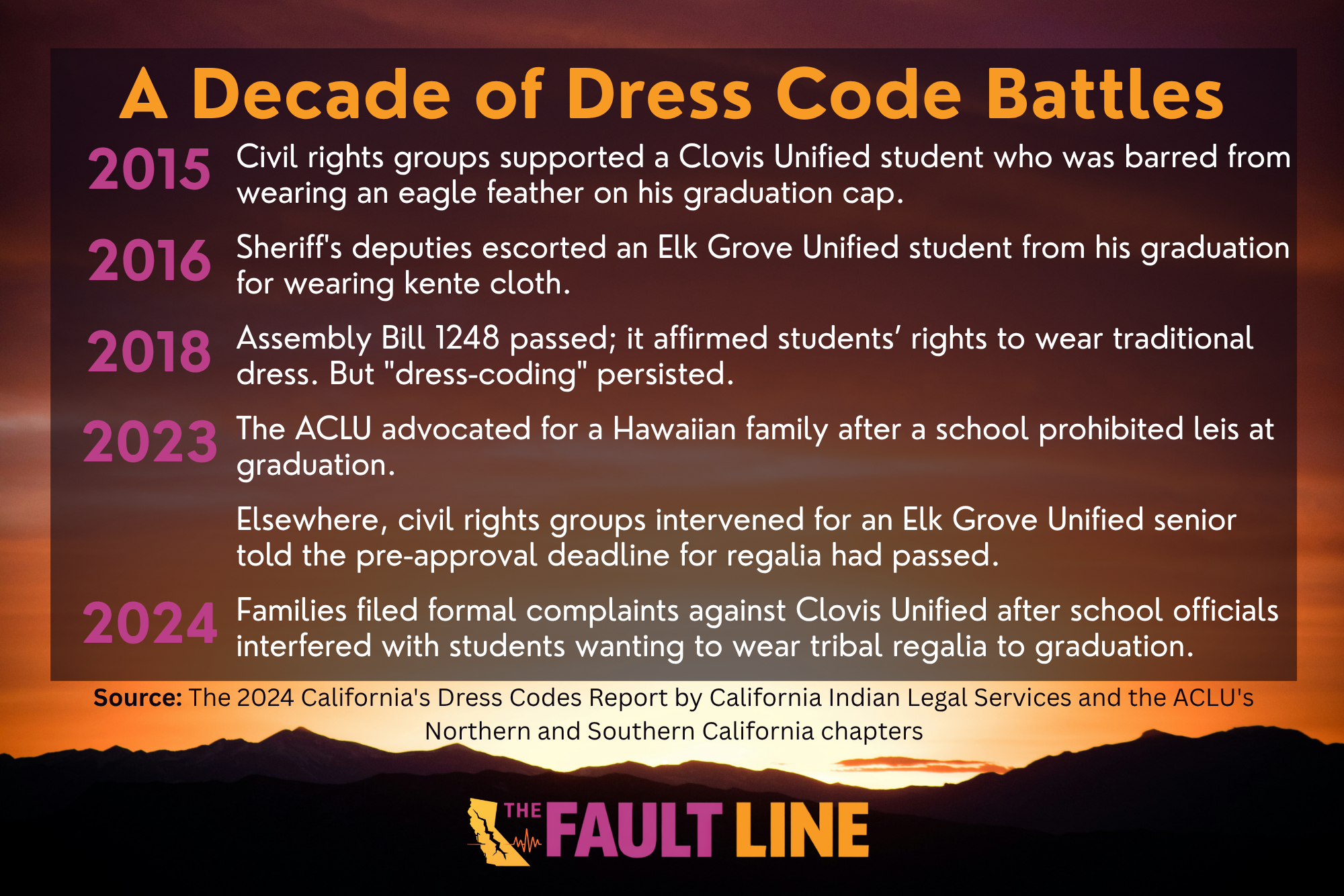
Over the past decade, school districts have not only targeted Native American students for wearing tribal regalia at commencement but also Black graduates who accessorize their caps and gowns with kente cloth to represent their African heritage, Petersen said. He added that it’s difficult to calculate how many complaints his law firm receives each year about tribal regalia specifically but noted that two districts in Fresno and Sacramento counties account for most of them.
“Some of the school districts that are hesitant to change have deep roots in the Gold Rush era and the mission system that came and dislocated Indian people,” said Ramos, who made history as the first California Native American elected to the state legislature in 2018. “There's more to it than just regalia.”
California’s statehood was not designed with the cultures and voices of the state’s first people in mind, Ramos said. Rather, white supremacist ideologies such as “kill the Indian, save the man” influenced policy.
“The different regulatory bodies actually had laws and ordinances that precluded cultural artifacts, cultural ceremonies, cultural languages from being included in the school districts because of the assimilation policies where people were trying to take away the culture, so that is really the underlying issue,” Ramos said.
A September 2024 report by California Indian Legal Services and the ACLU’s Northern and Southern California chapters found that culturally insensitive graduation dress codes remained common across California. Examining 50 school systems statewide, the groups found that districts routinely blocked students from wearing cultural adornments — even though California had passed a law in 2018 protecting that right.
The loopholes left by the older law allowed more than half of the districts analyzed to implement strict pre-approval policies. Some schools even required students to submit their sacred items for inspection weeks ahead of time.
Garcia, now 19, said her high school requested photos of her eagle feathers prior to graduation. “That's something my family has never done,” she said. “The thing is you don't get gifted with eagle feathers typically until the day of your graduation.”
Even if she had received her eagle feathers months early, she wouldn’t have allowed school officials to take pictures of them. The gifts are among the most honorable an Indigenous person can earn.
“You have to be very careful of who touches your feathers,” Garcia said. “You don't want bad energy or bad medicine going into them, especially if you're going to be wearing that on your graduation day.”
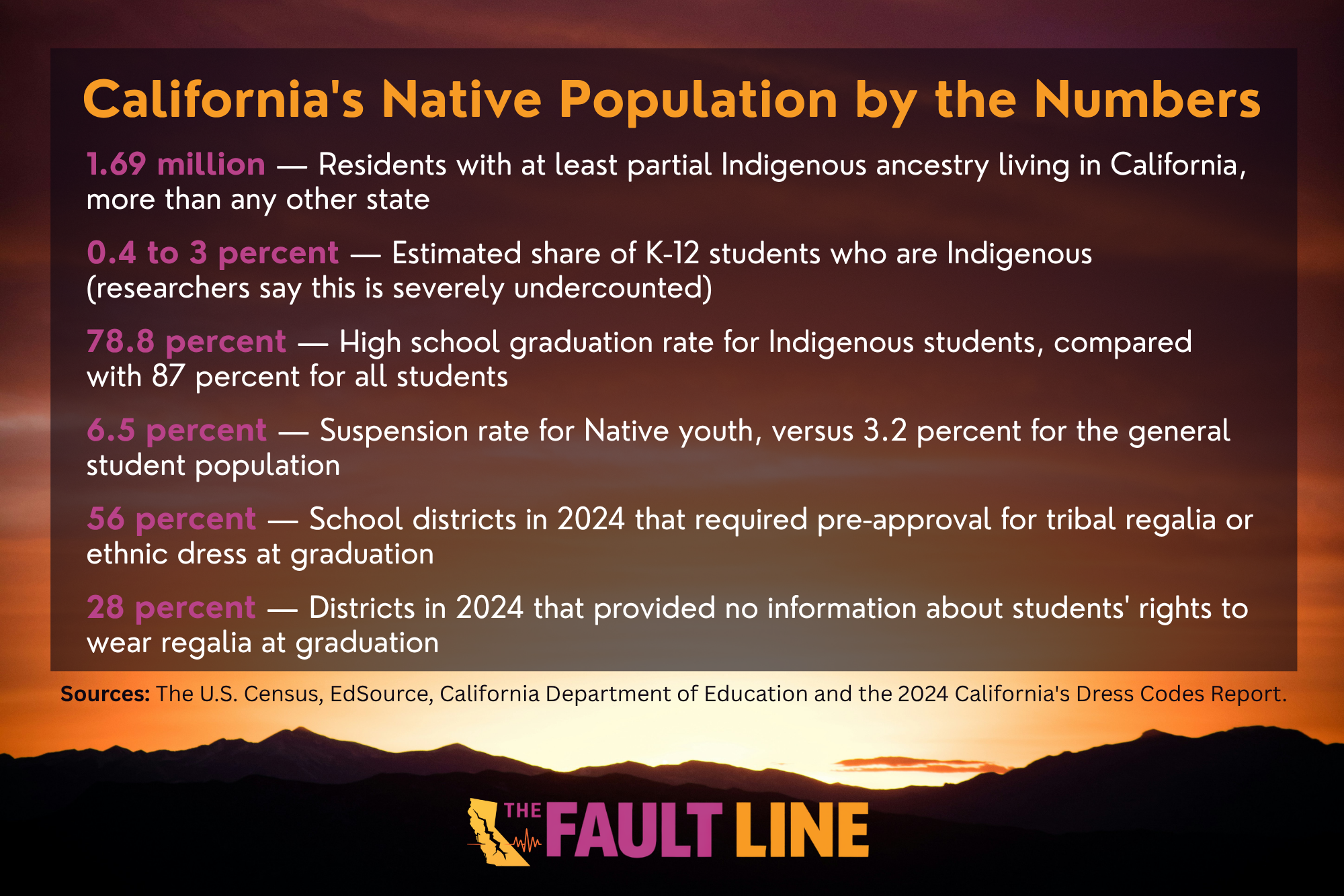
That occasion is all the more precious to California’s first people because their graduation rates lag behind the statewide average. According to the most recent data available from the California Department of Education’s four-year adjusted cohort graduation rate, Indigenous students have a high school graduation rate of 78.8 percent compared with a rate of 87 percent for all students.
California Indian Legal Services has repeatedly sued districts for restricting regalia at commencement. Petersen noted that some schools insist on a uniform appearance, while others treat Native students as interchangeable. They’ll decide to “let all Native people wear eagle feathers,” he said. They figure, “Well, we have a Pit River man who wants an eagle feather. Therefore, if we give a Yurok, a Luiseño or a Mono access — problem solved.”
This ignores that Indigenous students might also want to wear regalia specific to their tribe. Additionally, Petersen said, school administrators have attempted to impose their own views on what constitutes “traditional” adornments.
They treat “Indian people as museum pieces, frozen in time,” he said. They’ll reject beaded caps as traditional regalia by arguing that they didn’t exist in the 19th century. “What other culture is frozen in time?” Petersen asked. “None. You can change culturally, and it's inevitable that there are adaptations, evolutions and what not.”
He applauds AB 1369 for barring school officials from questioning the regalia families deem significant and eliminating confusing pre-screening processes.
“What I've been able to argue without any hesitation is when regalia is worn in good faith by a student, it's coming from the family; it's supported by the tribe,” he said. “There's nothing that they could wear that materially interferes with a graduation or substantially disrupts the graduation. So I think we're back to where we should be or should have been all along.”
Long before her senior year, Garcia had watched her two sisters and a cousin be denied the opportunity to wear their preferred regalia to graduation.
“They had never been allowed more than an eagle feather,” she said.
So she wanted to be prepared. In 11th grade, she decided she would not be intimidated into forgoing regalia when she graduated.
“Threats about whether or not you can walk and get your diploma is a good way to scare Native students into not showing up with an eagle feather,” Garcia said. “That's what they historically have always done — is let these students know, ‘If you show up with this, we have the right to tell you if you can walk or not.’”
Clovis Unified did not respond to requests for comment from The Fault Line News about these allegations. Garcia also accused administrators of saying that her regalia “would be such a distraction that I would ruin the whole graduation ceremony.”
Throughout this conflict, Garcia maintained over a 4.0 GPA, worked part-time and participated in advocacy and community events for Indigenous people. She felt appreciated during cultural gatherings but ostracized on campus.
“Not everyone wants to be friends with someone who's fighting the school, especially if they don’t understand why,” she said. “A lot of people just wanted me to comply with the school policies.”
She wishes her friends from various ethnic backgrounds — Laotian, Mexican, Japanese — would have banded together to defend their right to wear cultural adornments to graduation.
“But I don't know if they had ever thought about doing that just because everyone knows how strict the school is,” she said.
She found a champion in Tule River Tribal Chairman Shine Nieto, who learned about her fight to wear tribal graduation regalia on social media. He looped Garcia and Clovis Unified officials into a virtual meeting with California Indian Legal Services, Assemblyman Ramos and State Superintendent of Public Instruction Tony Thurmond. Shortly afterward, Nieto and Garcia traveled to the state capital to testify about the need for AB 1369.
“I won't lie. I was really nervous,” she said. But Nieto told her, “I didn't need to write anything down. I just needed to speak from the heart, and everything would come out from there. And, sure enough, it did.”
The bill passed; the school district relented. But Nieto still feared Garcia would be a target during graduation. As a student in the 1980s, officials told him he had to cut his hair to play football, prompting him to switch schools. As tribal chairman, he’s heard numerous complaints from Indigenous students about schools using dress codes to prevent them from representing their heritage. So he emailed Clovis officials with a reminder: “You said she could walk. If you pull any tricks, I hope your lawyer is better than mine.”
To ease her nerves during graduation, Garcia imagined what the land surrounding the ceremony was like centuries before it was a football field, when her people traversed it unimpeded by colonization. She imagined their footprints in the soil. When she finally crossed the stage, clad in regalia, her eyes brimmed with tears.
“I actually did it,” she said.

Fighting for her right to wear graduation regalia has only deepened Garcia’s connection to her heritage. At Fresno City College, she’s majoring in American Indian studies and sociology with the goal of working in Indian education for a tribe or for the state.
“At the end of the day, I just want to do something that directly or indirectly helps my people or my community,” she said.
She’s already gotten started. Last year, she was a fellow for the California Native Youth Collective, an affiliate of the Center for Native American Youth at the Aspen Institute, a global nonprofit focused on equity. The fellowship gives youth leaders the opportunity to advocate for Indigenous communities. In high school, Garcia revived the Native American and Indigenous People’s Club, which had been dormant since 2008. She also served on the Native American Youth Council at the Fresno American Indian Health Project.
This year, she’s an education liaison for her tribe, a role that entails reaching out to K-12 Native students in local school districts, including Clovis Unified. She said the district’s Title VI Indian Education program purchased tribal stoles for over 40 Indigenous graduating seniors, something she couldn’t have imagined just a few years ago.
As a student, she didn’t feel school officials took her seriously about the importance of tribal regalia. But her current role and public speaking experiences, particularly her testimony before the state legislature, has given her confidence.
Katy Stewart, senior program manager for the Center for Native American Youth, called Garcia “an incredible youth advocate.”
“We could not be more proud of her contributions,” Stewart continued. “Thanks to her work, more Native youth across California — and hopefully the country — will have their traditional regalia recognized and respected."
But Garcia also hopes her fight to wear regalia to graduation has an impact on her elders, many of whom were forced to assimilate whether or not they attended the boarding schools that terrorized Indigenous youth historically. They learned to hide their cultural identities and practice their traditions in private.
“For some of them, back when they were growing up, it wasn't a good thing to be Indian,” she said. “So, now I think about them watching young Native people graduate and being proud of who they are and where they come from, and I think that's very heartwarming.”
This article — produced by The Fault Line News — is available to republish for free. For republishing inquiries, please contact us.