They Earn Double the Federal Minimum Wage. In California, That's Still a Choice Between Rent or Food.
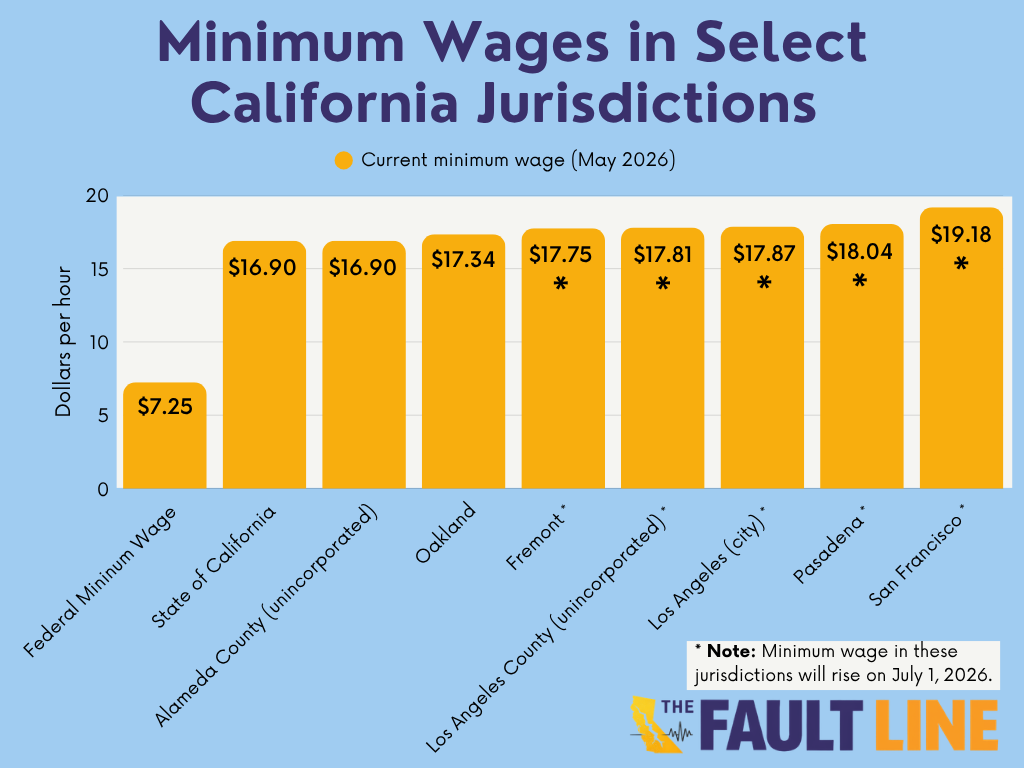
Essential workers say rising costs for housing, groceries and transportation have already swallowed the gains from California's new $16.90 minimum wage.


For Jeannette Diaz, 48-hour workweeks aren’t occasional but the norm. The restaurant server earns $18 an hour — above both the minimum wage of California and of Oakland, where she lives. Yet every dollar she earns is already spoken for, she said.
Her first paycheck of the month goes to rent and bills. The second covers groceries, with what's left going to family abroad. “Sometimes I clean a house or babysit to earn a little extra, but after an eight-hour workday standing, it’s really tiring,” Diaz said.
This year, California raised its state minimum wage to the nation's fourth highest — $16.90 — but the cost of rent, gas and groceries has far outpaced the pay of its lowest earners. Workers’ struggles prompted a coalition of community and labor groups in March to launch the “Oakland and Alameda Living Wage for All Campaign.” The coalition filed ballot initiatives that would require large employers in Oakland and Alameda County to pay a $30 minimum wage by 2030. Smaller employers would have a decade to raise their pay.
“If approved, the measure would position Oakland and Alameda County as the first in the nation to enact a $30 minimum wage,” said Keala Uchôa, communications manager for the Oakland-based Black Organizing Project, one of the coalition leaders. “The timeline and structure of the measure reflect the lived experience of workers across the region, where full-time employment increasingly falls short of covering basic costs.”
A similar effort is underway in Southern California. There, labor advocates are pushing the Los Angeles County Board of Supervisors to propose a $30 minimum wage, up from the current $17.81, which is slated to rise to $18.47 in July. That push follows the L.A. City Council’s decision last year to approve an ordinance that will give tourism workers a $30 minimum wage in 2028, when the city hosts the Summer Olympics.
For many Californians, $30 an hour would be life-changing. According to the Public Policy Institute of California, nearly 30 percent of residents are severely rent burdened — spending more than half their income on housing alone.
“The thought of being able to earn $30 an hour personally gives me hope of being more relaxed, of saving for an emergency,” Diaz, 55, said.
From Fremont to Inglewood, Californians told The Fault Line News that a $30 minimum wage could help free them from a cycle of scarcity. Many said they cannot afford housing on their own, while others said rising costs led them to try leaving the state.
Still, they expressed skepticism that bigger paychecks alone will solve California’s affordability crisis. They fear landlords and businesses will simply raise prices in response. For others — particularly immigrants and low-income workers who fear retaliation — wage theft remains a pressing concern.
What workers agree on, however, is that even in a state with a top minimum wage, their pay falls short of the realities of modern life.

Diaz once relied on tips to supplement her hourly wage. Then the pandemic happened.
“Business slowed down and tips dropped considerably,” she said. “With how expensive eating out has become, people can’t tip as much — especially if they come with the whole family. The bill is too high.”
Single, with only her income to depend on, Diaz used to work 14-hour shifts to make ends meet in the San Francisco Bay Area. But working for so long wore her out. Although she gave up the marathon shifts, many of her colleagues have not.
“I see the tiredness in their eyes, physical exhaustion, but what matters to them is the well‑being of their families and children.”
“I see the tiredness in their eyes, physical exhaustion, but what matters to them is the well‑being of their families and children,” she said. “Most of my coworkers work double shifts. That’s the reality for many cooks and servers.”
Diaz doesn’t have children, but her age alone is a risk factor: Women over 50 represent a growing share of the homeless population. Exorbitant housing costs, low wages and a gap in safety net programs — designed for mothers of minor children or retirement-age individuals — leave them in jeopardy.
But Diaz isn’t looking for social services support. She just wants her earnings at one job to cover her expenses. A $30 hourly wage could make that possible — that is, if companies don’t prune their workforces should the proposal succeed, she said.
“You worry that in our workplaces, they might fire people because they can’t afford to pay everyone, and they might feel forced to reduce staff,” she said.
Businesses often warn of job losses, but a 2023 study by researchers at the University of California, Berkeley, found the opposite: Pay increases reduce turnover and vacancies without cutting jobs.
A $30 hourly wage “would also strengthen local economies by increasing consumer spending,” said Uchôa of the Black Organizing Project. “As wages rise, workers are more able to spend money in their communities, supporting restaurants, retail shops and neighborhood services.”
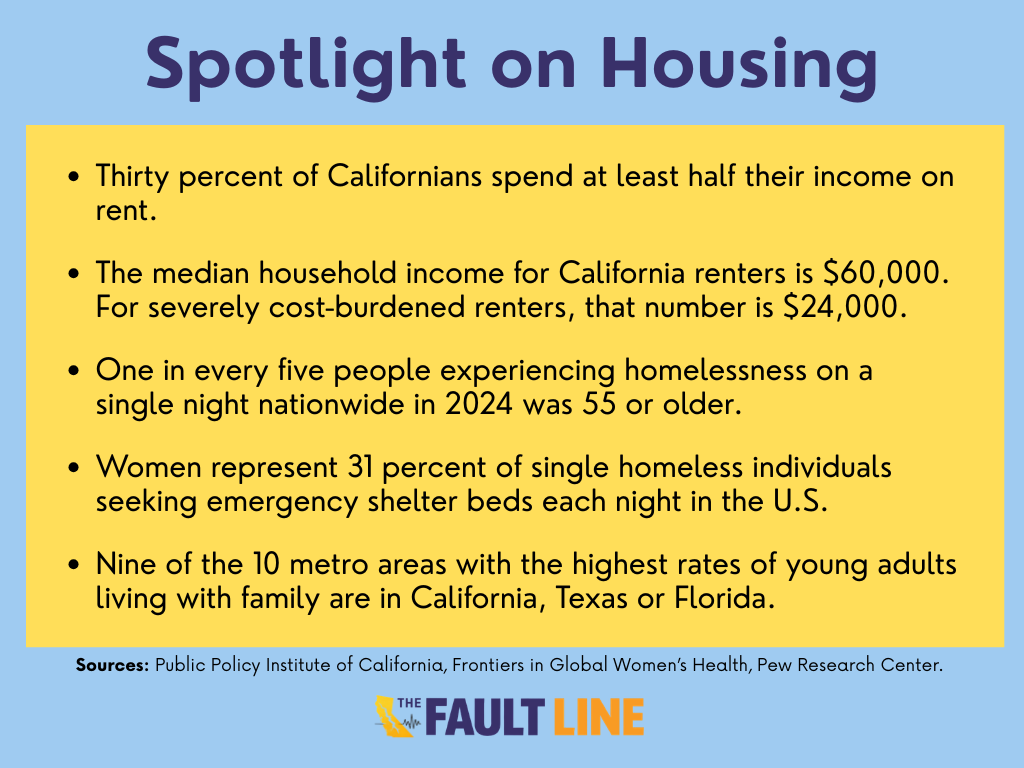
Uchôa acknowledges that even $30 is insufficient for some families. In Alameda County, a two-parent, two-child household would need over $40 an hour to cover basics. “Many would still be short of a true living wage,” she said, “but the policy is intended as a meaningful step toward greater stability.”
While Diaz believes a $30 hourly wage would be transformative, she worries that if rent and other cost-of-living expenses rise as well, a pay increase wouldn’t make much of a difference in her finances. She’s not alone. Other workers who would welcome better pay question whether inflation will offset the gains of higher wages.
Miguel Pacheco, like Diaz, earns $18 an hour as a food service worker. But he’s married with four children, 375 miles south in Pasadena. He works with his wife at Europane Bakery, a small business in the city’s upscale Old Town district. Pacheco has worked for the bakery for three years — serving customers, washing dishes and cleaning generally. His wife, Nancy, has been manager for 16 years. She oversees merchandise, production and staff, and earns close to $30 per hour.
Yet, the Pachecos, both in their 40s, struggle financially. They share a five-bedroom home with another family and still pay a monthly rent of nearly $3,000. Their eldest child, 24, continues to live with them, finding housing costs in the area too high to cover on his own as he pays off trade school loans.
If the Pachecos both earned $30 hourly, they know it could help their family, but they suspect the marketplace would respond by spiking the price of goods and services.
“They increase the minimum wage, and then everything increases — rent, produce, gas,” Nancy said. “It makes no difference. You’re still in the same place.”
Since monthly rent on a storefront in Old Town Pasadena can exceed $10,000, the Pachecos worry that higher labor costs could lead to staffing cuts that would make them even more vulnerable financially.
As it is, gentrification in the city has intensified over the past two decades, driving out working-class residents and prompting political scientist Peter Dreier to dub Pasadena “a tale of two cities” due to its class divides.
“They want to make Pasadena for rich people,” Miguel said. “Here in Pasadena, everything is expensive, so people are moving out.”
Fed up with San Gabriel Valley costs, the Pachecos moved to Las Vegas a decade ago but returned after eight months. The scorching Nevada heat overwhelmed their children, making it difficult for them to play their beloved soccer. And the low wages the couple earned caused them to rethink their move. At the time, Nevada paid barely above the $7.25 federal minimum.
Since 2009, the federal wage floor hasn’t budged, which ignores the impact of inflation, COVID-19 and the nation’s foreign policy on the economy. In April, Rep. Delia Ramirez of Illinois introduced the Living Wage for All Act with the support of labor advocacy groups like One Fair Wage. The act would raise the federal minimum wage to $25 — the base pay economic justice leaders say workers need to survive.
The Pachecos found that cheaper rent didn’t improve their quality of life in a state where they earned little more than the federal minimum. Struggling on low wages, they decided to leave Nevada.
“We would have still needed two jobs,” Nancy said. “California is expensive, but we love it here.”
Not all struggles are equal. When Uno, a 54-year-old caregiver in Fremont, moved to the San Francisco Bay Area from the Philippines, he came for the American Dream. Instead, he’s experienced irregular hours, wage theft and labor trafficking, he said.
Uno, only identified by his first name due to his immigration status, arrived in the country roughly 13 years ago. An acquaintance lured him to the United States with promises of obtaining a green card and a well-paying job as a cook, since Uno previously worked as a sous-chef. But the work secured for him approximated slavery, he said.
For six months, the family he worked for kept him largely indoors, Uno recalled. He slept in the garage, subsisting on hot cereal and the occasional household leftover. He lost half his body weight, but his employers told him he had no rights because he was undocumented, he said.
“I had a long beard, long hair. I only had two pairs of pants.”
The family paid him a fraction of what they owed him — telling him they’d deducted the cost of his food and shelter from his earnings, Uno said. “We are good employers, and you’re staying here for free,” he recalled them saying. “We're taking care of you, so Uno, you help us.”
In those early months, Uno hadn’t experienced even mundane activities like using public transportation. On one rare outing, he encountered a Walgreens drug store for the first time. “I bought cookies for $1. I was very happy because most of the time I ate oatmeal.”
When he tried to leave his employers, they would curse at him and tell him he lacked gratitude, he said. Uno reached out to relatives nearby who wept when they saw how gaunt and overworked he was. They asked if he’d tried to get help, which motivated him to hatch a plan. He told his bosses he had family members in law enforcement who were coming to get him. His relatives weren’t actually police officers, but his employers finally let him go.
“I thought I had no rights,” Uno said. “My employer always told me, ‘You have no rights here. You will go to prison. You will die in prison.’ They brainwashed me.”
“My employer always told me, ‘You have no rights here. You will go to prison. You will die in prison.’ They brainwashed me.”
Megan Whelan Escobar, interim director of the California Domestic Workers Coalition in San Francisco, said Uno’s experience, while extreme, reflects the serious and ongoing reality of labor trafficking. President Donald Trump's aggressive immigration enforcement policies, she added, make domestic workers more susceptible to abusive and exploitative employers.
“More than ever, we must listen to domestic worker leadership and their demands for stronger protections, safe and accessible pathways to report abuse, investment into community-based organizations that support workers, and real enforcement to ensure that exploitation is prevented — not ignored,” Escobar said.
A March report from Rutgers University’s Workplace Justice Lab found that 20 percent of California’s domestic workers — nannies, house cleaners, home care aides — experience wage theft. The average victim loses $4,200 per year, or 22 percent of their earnings. The state’s domestic workers collectively lost $282 million annually. Non-citizens, like Uno, were among the domestic workers particularly likely to experience wage theft, according to the study.
Jake Barnes, lead author of the report and research program manager for the Workplace Justice Lab, said the amount of earnings domestic workers lose has a devastating impact on their lives.
“It’s huge,” he said. “Someone has their take-home pay, and they’re not getting $1 out of every $5. Forty-two hundred dollars over the course of a year is about $300 or $400 a month. That can be a car payment. That’s groceries. That’s a huge amount of money, especially when this represents 20 percent of your earnings when you're already making the minimum wage, which is already difficult to raise a family on.”
Since wage theft is likely to increase as the minimum wage rises, Barnes said, state officials need to invest in enforcement to ensure that vulnerable workers are paid what they deserve.
Domestic workers in private homes are especially vulnerable because many do not know their rights or fear reporting abuse. Undocumented workers worry they’ll be detained or deported if they seek help from a government agency. On the other hand, private home employers often need educating on the standards they should uphold for domestic workers.
“It's not like all employers of domestic workers are willfully not following the law,” Escobar said. “More than two million homes in California do hire domestic workers, and the majority of employers need guidance. Anybody can hire somebody to work in their homes to support them with their childcare, their senior care or their household needs. There's such a low barrier.”
Proposed budget cuts to labor rights outreach programs in San Francisco could make domestic workers more prone to exploitation, Escobar fears.
“Outreach and education are core services,” she said. “When you eliminate these programs, you are effectively rolling back rights that workers already have.”
Uno now knows his rights well. After his harrowing introduction to the United States, he became active in labor organizations, including the California Domestic Workers Coalition. He now earns $20 an hour, more than the $17.75 minimum wage in Fremont. But the idea of a $30 wage feels distant to him.
He could certainly use the boost. His work is on-call and irregular — sometimes seven-hour shifts, other times four-hour ones.
“They call me if someone cannot go to work. ‘Uno, can you cover this job?’”
He pays $2,500 monthly rent for a one-bedroom apartment in Fremont. He takes gig jobs cleaning and gardening to supplement his caregiver income. Since his ex-wife cannot work due to a disability, he supports her and their teenage son, both of whom moved to the United States after he did.
“My only happiness,” Uno said, “is to provide for my son.”
In Southern California, Kennedy Boxie — a 20-year-old from Inglewood — may be young, but she already knows how life can change with a higher paycheck. Nine months ago, Boxie earned minimum wage as a CVS cashier. In four years, she got exactly one raise: 50 cents. She worked 40-hour weeks plus overtime to get a check that still fell short.
“I was broke by the end of week one,” she said.
In search of better employment prospects, Boxie joined the Los Angeles Black Worker Center’s “Ready to Work” program in which she learned job interview and resume-building skills. The training paid off, helping her land a role as a law clerk in Santa Monica. She now makes $23.94 an hour after a recent raise — well above minimum wage.
“Now, I don’t have to overwork myself,” she said. “I get a normal paycheck, and it’s way bigger.”
But she doesn’t envision moving into her own apartment on her salary. She now lives with her great-grandmother. Nine of the 10 metro areas with the highest rates of young adults living with family are in California, Texas or Florida, according to the Pew Research Center.
All of Boxie's friends live with relatives. Her mother recently moved to Houston because she could no longer afford Playa Vista on L.A.’s Westside.
“I’m 20. I feel like I should be planning to move out,” Boxie said. With her paycheck consumed by her car note, insurance, phone bill and groceries, she suspects she could only afford a studio apartment in a questionable neighborhood. “I’d probably have to pay for parking,” she said. “It’s unrealistic.”
Boxie is clear-eyed about what a $30 wage would mean: “I wouldn’t feel like I’m constantly catching up. If an emergency comes up, I won’t fall behind.”

As Boxie starts her career, Jeannette Diaz, up in Oakland, has spent nearly two decades in an industry that has yet to grant her stability.
She has a message for the politicians and business owners hesitant to support a $30 living wage. She wants them to know that restaurant workers strive to provide good service every day. Even when they experience financial difficulties, illnesses or other setbacks, they leave their problems at the door.
“Inside, we offer a smile and serve food made with love and flavor,” she said. “I hope my voice reaches many, and that we achieve better pay and a more encouraging future.”
This article — produced by The Fault Line News — is available to republish for free. For republishing inquiries, please contact us.