They Met Martin Luther King Jr. Californians Remember His Visits.
They expected an icon. They found a master organizer — and pool shark — who listened more than he lectured during his repeated trips to the state.
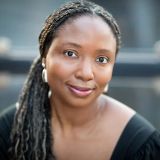

Before Lenneal Henderson met the Rev. Martin Luther King Jr., he assumed the activist would be as physically towering as his influence in the civil rights movement. Instead, he found King to be shorter than average after seeing him at the University of California, Berkeley, in May 1967.
“We were all shocked,” recalled Henderson, who was a college junior then. “We expected somebody James Earl Jones–sized. And here was this very compact man — maybe 5 feet 6, 5 feet 7 — immaculately dressed, sharp as a tack.”
King may not have been the imposing figure Henderson anticipated, but he quickly demonstrated his ability to command a room — or a student lounge. After asking to visit one, the civil rights leader dominated the young men in the Afro-American Student Union at a familiar pastime: billiards.
“He proceeded to beat us mercilessly at pool,” Henderson said. “So he had our attention.”
For King, pool was a recruiting technique. He got young men to attend his Atlanta church by beating them at the game, Henderson said, replicating the method in California to mobilize students to support the Poor People’s Campaign. This multiracial push for federal anti-poverty policies prompted King’s 1967 trip to the Golden State, but it was far from his only visit.
In fact, King traveled throughout California — from Sacramento to San Diego — multiple times during the decade before his 1968 assassination, indicating the West played a critical, if overlooked, role in his civil rights strategy. He came to the state to fight for fair housing, racial equality and economic justice as well as to fundraise for the movement and oppose the Vietnam War. His itineraries consistently included college campuses, where he connected with students.
For its inaugural article, The Fault Line interviewed individuals who encountered King as undergraduates in California. They drove him to campus, shared meals with him or listened to him from the crowd. Now in their 70s and 80s, they contend that King made them feel heard as young people, inspiring them to work for change.

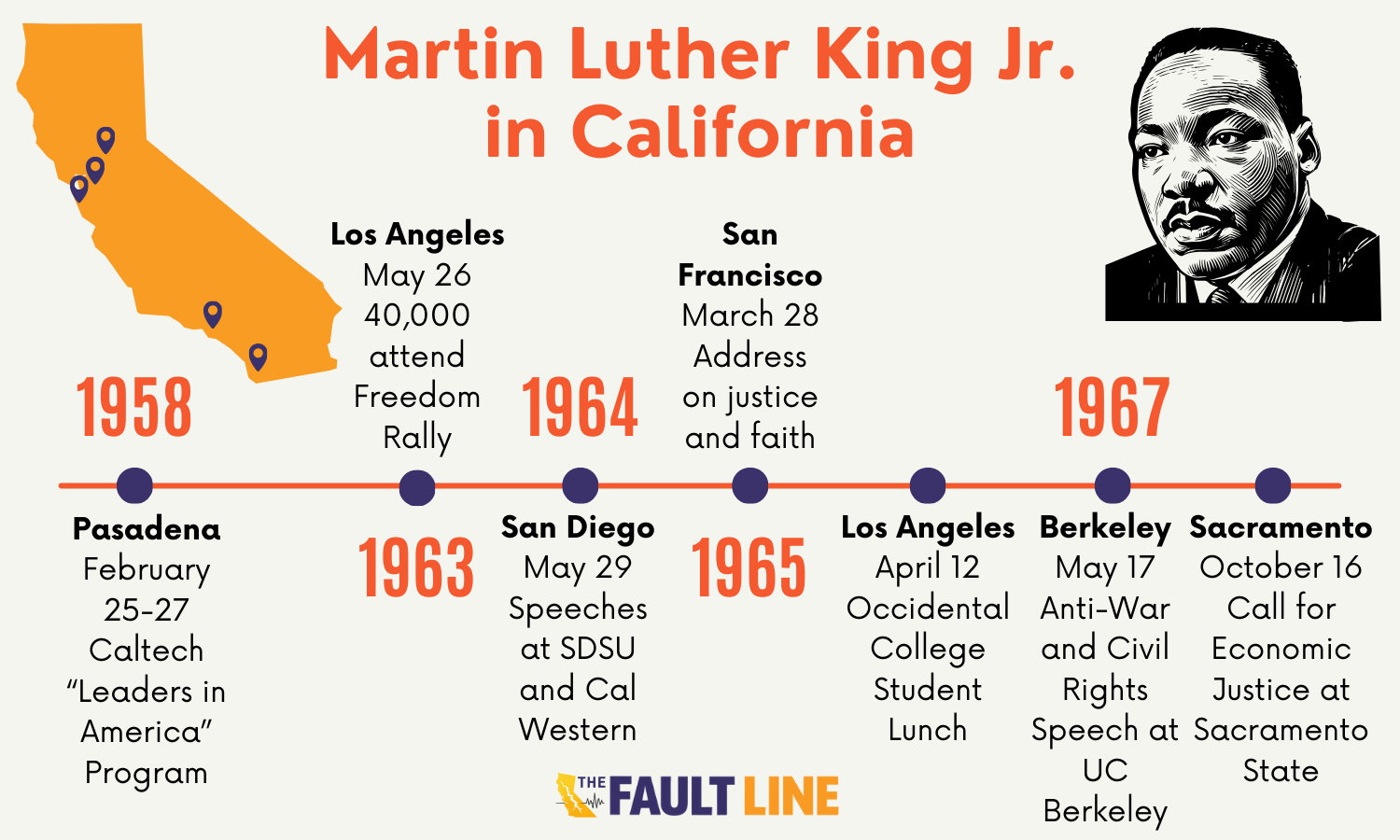
On May 17, 1967, over 7,000 students packed into Sproul Plaza to hear King criticize the federal funding spent on the Vietnam War and the withholding of resources to combat poverty. In the heart of UC Berkeley’s campus, they sat on rafters or on each other’s shoulders to get a clear view of the activist. But Henderson did not have to watch him from a crowd. As a member of the Afro-American Student Union, he belonged to a select group of students who made up a private audience for him.
King talked to them about forming a Poor People’s Campaign that included a coalition of Black, Indigenous, Latino and poor white communities. “He wanted to be much more diverse,” said Henderson, now 79 and an adjunct professor of government at the College of William and Mary.
Beyond his movement for economic justice, King urged the Black students to engage in local activism. Henderson recalled him saying: “I understand that down the street from the campus, there is an all-Black school … where they send the so-called difficult students. You go down to that school and make some difference.”
Inspired, Henderson and his peers persuaded the university to give them $20,000 to launch a service project focused on the school. But King’s influence on him didn’t stop there. Henderson, born in New Orleans and raised in San Francisco, recognized that segregation persisted in both the South and the North. In the San Francisco Bay Area, Black Americans were largely relegated to cities like Oakland, which became the birthplace of the Black Panther Party in 1966. That same year, the Hunters Point Rebellion took place in a Black neighborhood in San Francisco after a white police officer shot and killed a Black teenager suspected of auto theft.
This racial climate made it clear to Henderson why King’s civil rights message mattered. Compelled to act, Henderson enrolled in a sociology course that required students to travel to Washington, D.C., for the Poor People’s Campaign. But King didn’t live to see the event. He was assassinated just weeks before on April 4, 1968, sparking civil unrest across the country.
Henderson learned of the heartwrenching news while visiting relatives in New Orleans before proceeding to the nation’s capital. Having met King made the assassination sting all the more. “I then got on the bus the next day to Washington, D.C., and as the bus was coming into the Virginia suburbs, coming into Washington, you could see the smoke and flames from the riots that were taking place,” Henderson said. “It was really a surreal set of experiences.”
On April 12, 1967, just under a year before his assassination, King visited Occidental College in Los Angeles to give a talk on “The Future of Integration.” At Oxy, as the school is nicknamed, the first class of Black students had only graduated 15 years earlier. In his speech, King called for legislative and social change to truly integrate the nation.
It was one of many trips the civil rights leader made to Los Angeles over the preceding decade. He traveled to the city for the Democratic National Convention in 1960, to appear at the star-studded Los Angeles Freedom Rally in 1963 and to hear the concerns of the Black community after the 1965 Watts Rebellion, among several other visits to churches, universities and stadiums. Civic leaders weren’t always welcoming. When the Rev. Fred O. Doty asked King to address his church in L.A.’s San Fernando Valley in 1961, neither the mayor nor the city council would greet the activist at the airport. State lawmakers also declined. Just one official, L.A. County Supervisor Kenneth Hahn, agreed to usher him into the city.
Yet, King attracted throngs of spectators during his L.A. appearances. At Occidental, King drew a record crowd in Thorne Hall. “Yes, we are tied together in a single garment of destiny, caught in an inescapable network of mutuality,” he told over 1,000 students and faculty at the private liberal arts college.
Alice Walker Duff was then a 19-year-old Oxy sophomore with mixed feelings about the civil rights leader. Black power had reshaped the politics of young activists, particularly those from Northern and Western cities. Walker Duff — who grew up in New York with an older sister attending the Bronx High School of Science at the same time as Stokely Carmichael — questioned King’s focus on integration.
“We were more militant,” she said. “More focused on building the Black community — nation building — rather than integrating into white institutions.”
Despite her doubts about this strategy, Walker Duff participated in a group lunch with King. There were perhaps 10 students, almost all Black. King didn’t lecture them; instead, he asked questions. He wanted to know who they were.
“He was very humble,” said Walker Duff, now 78 and the co-founder of the nonprofit child development agency Crystal Stairs Inc. “He was genuinely interested in us.”
When students raised concerns about Black empowerment, they were surprised to learn that King agreed with them.
“The publicized dichotomy between Black Power and King didn’t really hold up,” Walker Duff said. “He was very interested in building Black strength and power, very supportive of Black students, of historically Black colleges.”
King himself earned a bachelor’s degree in sociology from historically Black Morehouse College in 1948. When Walker Duff dined with him, he also spoke out against the Vietnam War and economic injustice — themes becoming central to his work. Walker Duff left the meeting with a more complicated view of his philosophy.
“My appreciation for him just grew,” she said. “He was deeply impressive.”
Martin Luther King Jr. addresses students at Sacramento State University on October 16, 1967. / YouTube
In 1967, King’s trips to California not only included Los Angeles and the Bay Area but also the state’s capital — Sacramento. On October 16 of that year, he visited California State University, Sacramento (Sac State) to deliver an address to more than 6,000 spectators at Campus Stadium, now Hornet Stadium.
“His talk was really an inspiration for the importance of standing up for social justice, even when your views are divergent, and being strong and courageous in that effort,” said Marcellene Watson-Derbigny, Sac State’s associate vice president of student affairs. To mark the 50th anniversary of King’s visit to the university, Watson-Derbigny co-organized a celebration featuring an archival exhibit made up of photos, posters and other mementos.
During his speech, King pressed his audience to condemn the social inequities that leave the oppressed few options but to lash out in violence.
“But after all, a riot is the language of the unheard,” he said. “And what is it that America has failed to hear? It has failed to hear that the plight of the Negro poor has worsened over the last few years. It has failed to hear that the promises of freedom and democracy have not been met, and it has failed to hear that large segments of white society are more concerned about tranquility and the status quo than about justice, humanity and equality.”
When Ralph Clem reflects on May 29, 1964, the day he heard King speak at San Diego State University, he’s filled with gratitude. Somehow, as a college junior, he said, “I had the wisdom even then to go to his speech.”
Just months before the civil rights leader came to San Diego State, Time magazine named him its Man of the Year. And the prior year he’d given his legendary “I Have a Dream” speech at the March on Washington for Jobs and Freedom. But he had yet to achieve other milestones. The Civil Rights Act of 1964, which outlawed segregation and discrimination on the basis of race, sex or national origin didn’t become law until July 2 — just a month after his San Diego State visit. Moreover, King wasn’t announced as a Nobel Peace Prize winner until October 14, 1964, when he was just 35, the youngest recipient in history at that time.
Short of those accolades and widely branded a “race agitator,” King faced opposition when he arrived in San Diego, known then as “the Mississippi of the West,” said Seth Mallios, an archaeologist, anthropologist and historian who has written about King’s 1964 visit to the city.
“In 1960 San Diego, there was nothing progressive about what was going on in the city and region, socially, culturally, politically,” said Mallios, a professor of anthropology at San Diego State. “The town was highly segregated on multiple fronts. There were only three neighborhoods that would rent to African Americans. Black people were turned down for loans from banks. There were very important cases of individuals not being able to work at even the most basic places like San Diego Gas & Electric or Woolworth’s.”
King headed to San Diego, as well as other parts of the state, to fight against Proposition 14. The controversial ballot initiative aimed to overturn the Rumford Act, an existing state law that barred racial discrimination in housing when there was no federal policy prohibiting it. The proposition would have given property owners the right to refuse to sell or rent to whomever they chose.
“When he comes to San Diego, he's met with protesters,” Mallios said. “They're calling him a communist. They are telling him to go home.”
For Clem, the political context of King’s visit was secondary then. He went with a friend because: “Why would you not — if you're interested in your country, if you're interested in politics, if you're interested in social change?”
Clem, who is white, had grown up in San Diego attending one of the city’s few racially integrated high schools. Whites, Blacks, Asians, Filipinos, Japanese Americans and Samoans took classes together, he said, with little overt conflict. That environment shaped his sense of justice well before King arrived on campus.
“I was aware of social issues,” he said. “It goes back to the environment in which I grew up.”
At the Greek Bowl, Clem became transfixed by King’s argument. “Why are people treated unequally?” Clem remembers King asking. “What possible reason could there be for doing it? He set up his main point and then basically challenged you to come up with some counterpoint, but you couldn’t because there wasn't one. It was a very, very, very persuasive way of convincing your audience.”
He remembers King’s commanding presence and powerful voice — and oddly, the shirt he himself was wearing: a short-sleeved Madras shirt he had bought with his own money. “I can’t remember what I had for breakfast,” Clem, now 82, joked. “But I remember that shirt.”
While King’s visit was a “defining moment” for Clem, it proved to be unsuccessful for the civil rights leader. Proposition 14 passed with two-thirds of the vote. The measure was eventually struck down by the California Supreme Court, but the electoral result was devastating.
“When they did analysis on the voters, it was all along race and gender and party lines,” Mallios said. “All of these white male Republicans were the ones that voted in great numbers to allow discrimination in housing, and some of the people that were behind this proposition started in San Diego. They actually met at the El Cortez Hotel to have their first meeting to get Prop. 14 on the ballot.”
Clem, a retired U.S. Air Force general and professor emeritus of geography at Florida International University, doesn’t remember King’s San Diego visit through the lens of success or failure. Rather, he measures it in terms of what it meant to him personally as a young man.
“I had a seat at history in the making through no special qualities of my own,” he said.
King’s relationship with California began earlier than many people realize. In February 1958, three years after the triumphant Montgomery bus boycott, King traveled to the California Institute of Technology (Caltech) in Pasadena, California, near Los Angeles. It would be his first of three visits to Pasadena, where he also spoke about race relations and the church’s role in social change at Friendship Baptist Church in 1960 and 1965.
His initial visit came at the invitation of the Caltech Y’s “Leaders in America” program, which brought prominent national figures to campus to meet with students and faculty. Kent Frewing, then a Caltech student and board member of the Caltech Y, still remembers meeting King. He was 20, and King was 29.
“I believe that the Caltech Y board felt very privileged to have Dr. King visit campus because they were likely all supporters of civil rights for all Americans, and we anticipated that Dr. King would have many demands on his time,” Frewing, now 87, recalled via email.
Frewing volunteered to drive King and his wife, Coretta Scott King, around Pasadena because he was the rare student with a car.
“I let the Kings sit together in the back seat,” Frewing said. “I think they conversed quietly.”
The vehicle was a 1950 Ford that became the talk of the Frewing family because it transported the two civil rights leaders. But during the 1960s, he either sold or traded it, Frewing said.
“I felt lucky to be asked to drive the Kings, and to attend some of the meetings they had on campus,” he said.
King was not visiting Pasadena to rally tens of thousands or confront white supremacists. He was there to talk to the Caltech community about leadership, ethics and justice.
King’s visit did not shape Frewing’s work directly, as he went on to spend his career supporting space science at NASA’s Jet Propulsion Laboratory. It did, however, coincide with a broader social shift toward fairness in hiring. When King was assassinated in 1968, Frewing was working on a spacecraft test in the Mojave Desert. He remembers feeling both devastated and furious.
Since then, Frewing said, “I’ve been grateful for Dr. King’s courage, energy and initiative.”
King’s California trips did not generate instant victories, but they did offer the students who encountered him an invitation to step forward. On campuses across the state, King treated young people as equals — encouraging them to effect social change locally and nationally.
For Henderson, who went on to meet King’s widow in the 1990s, the legacy of the civil rights movement was the bravery of its leaders.
“Here are people who had every reason to be fearful, afraid,” Henderson said. “They were the paragons of courage. They didn't fight racism from afar. They went right to the scene. To have that level of courage is really inspirational.”
This article — produced by The Fault Line, an independent California journalism project — is available to republish for free. For republishing inquiries, please contact us.