She Got a Green Card. She's Still Terrified.
After crossing the border as a traumatized child and waiting years for legal status, a California teacher finally became a permanent resident. Yet in today’s immigration climate, safety continues to feel out of reach.

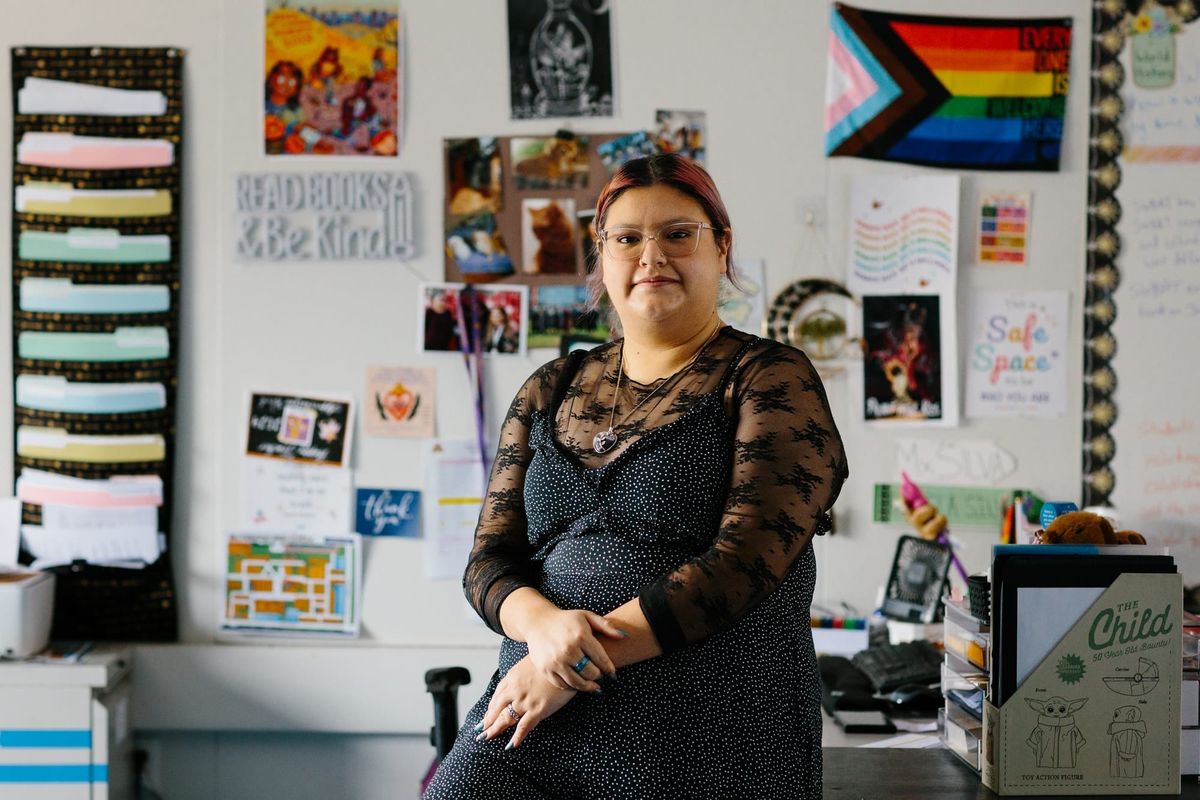
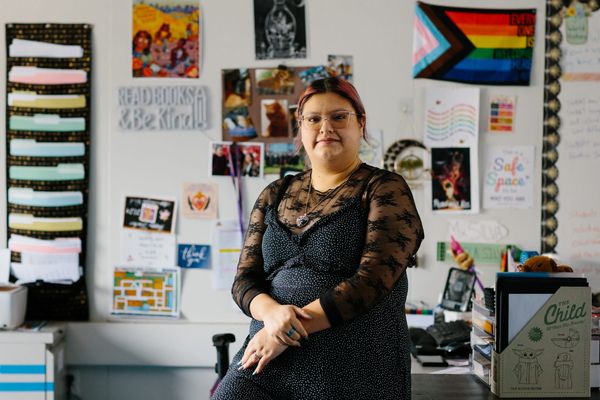
LYNWOOD, Calif. — Tucked inside a trailer at Lynwood High School — where backyard chickens squawk in the distance — Daniela Silva Alvarez’s classroom tells a story. The globes on display and glossy maps on the walls speak to a life spent straddling two countries: the United States and Mexico.
An LGBTQ+ flag hangs near a sign that reads “Mx. Silva” — reflecting her use of she/they pronouns. Another declares the classroom “a safe space for immigrants,” the reassurance she longed for as a child who knew few people with her legal status: sin papeles, undocumented.
Nineteen months ago, in this same classroom, Silva Alvarez received a phone call so life-changing that they remember the exact moment it came: 3:40 p.m.
“Your application has been approved,” their immigration attorney said. “Your green card is in the mail.”
The news stunned Silva Alvarez, then 25. Tears streamed down their cheeks, and they couldn't stop thanking their lawyer. They called everyone they knew.
After journeying 1,900 miles from a rural village in Central Mexico to California without legal status at 7 years old, they had secured permanent residency for the first time.
“I was in shock, but I was so happy,” they said.
But a green card, she would learn, doesn’t end the fear.
Three months after Silva Alvarez got the news, Donald Trump won the 2024 election.
His administration quickly began expanding immigration enforcement — even detaining people with legal status. The headlines revived fears Silva Alvarez had carried since childhood. But now she’s concerned for both herself and her students and their families.
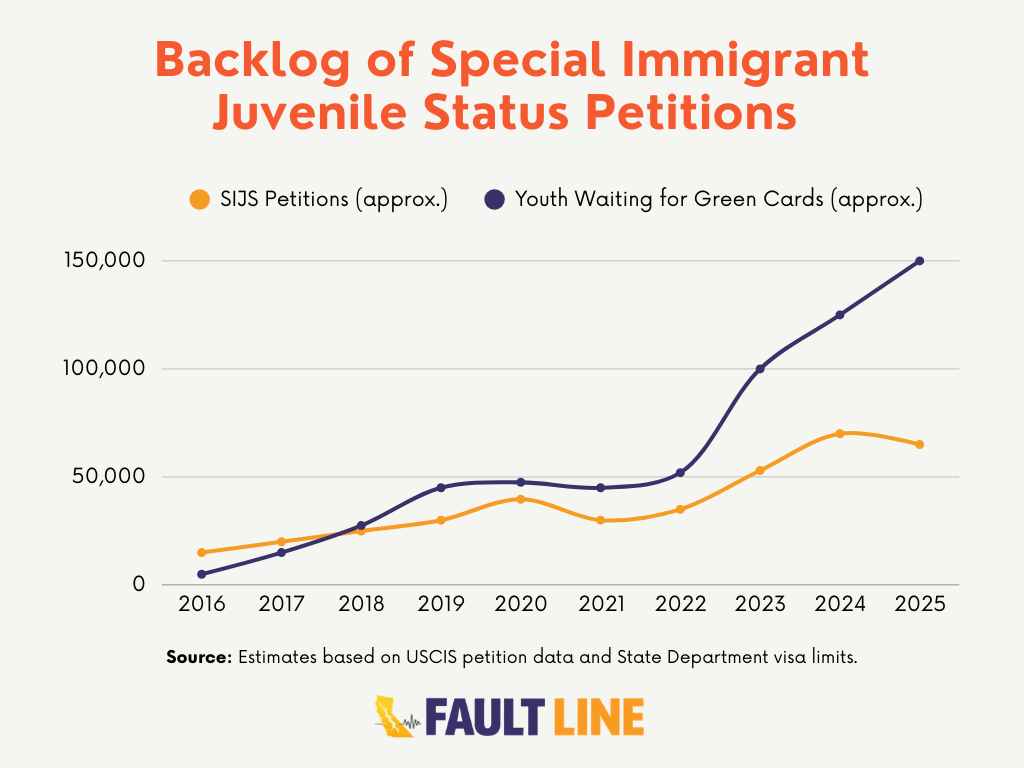
Her own relatives face similar obstacles: Six months after Silva Alvarez applied, her younger sister filed for a green card, but a visa processing backlog has delayed the paperwork. A recent federal lawsuit over work permits and deportation protections for immigrant youth has added to the uncertainty of those waiting.
For Silva Alvarez, a green card alone can't grant liberation. True security will come when her family members on both sides of the border enjoy the same privileges she’s had: to pursue higher education, earn a living wage, travel freely and advocate for her community. Obtaining legal status, then, didn't represent the end of a chapter but a call to action for her fellow immigrants — one she’s answered by pairing teaching with advocacy and sharing her own immigration story.
“There are so many misconceptions about undocumented immigrants,” she said, “that we don't pay taxes, that we're a drain on the system, that we're benefiting from public benefits. None of that is true. We contribute so much to this country, and we just want to be able to go out and take a walk down the street without living in fear.”

Growing up in Reseda, a neighborhood in Los Angeles’ San Fernando Valley, Silva Alvarez questioned whether she could make a life for herself in a country where her legal status kept interfering with her ambitions.
She may have been a small child upon entering the country, but she always knew she lacked papers. She also knew why she and her sister left Mexico: her mother's physical and psychological abuse of them, she said.
Unsure what would happen if the torment continued, a concerned family member brought the sisters to the United States. Today, Silva Alvarez remembers that journey “very vividly” but prefers not to recount it.
“It was a really traumatic thing for me,” she said. “It took years of therapy to be able to even tell that story without sobbing my eyes out, but, yeah, it's stuck in my mind.”
Once stateside, their undocumented status didn’t appear to affect their day-to-day life. But that changed during their teenage years as a participant in high school robotics contests. Competing required traveling both within and outside California. The relative who raised them — whose identity is withheld here because of his legal status — objected to Silva Alvarez making many of these trips, concerned they would be detained.
“No, you're not going because it’s too close to the border,” he told them about a San Diego trip. “When I had to go to Kentucky, to get on a plane, we had a huge fight,” Silva Alvarez recalled. “It's that fear of ‘You can't do that. You don't have your papers.’”
At the time, all Silva Alvarez could think about was how good these competitions would look on their college applications. They deemed their relative unreasonable and unsupportive when, now, at 27, they recognize that his worries were warranted. “It's not until you grow up that you say, ‘Wow, look at his level of sacrifice.’ I'll always be so grateful and admire him for his courage and the things he's gone through.”
The nurturing environment of her school made it hard to process her caregiver’s worries as a teen. Her teachers knew about her legal status but insisted: “You can do whatever you set your mind to.”
Still, she sometimes felt different. In 12th grade, she watched school counselors help her classmates apply for federal financial aid to attend colleges nationwide. Silva Alvarez, barred from federal aid, muddled through California Dream Act paperwork alone. The policy offers immigrant students financial assistance to attend schools in state. She ended up at the University of California, Merced, enrolling in 2017.
During her first year of college, staff in UC Merced’s legal services clinic helped her apply for Deferred Action for Childhood Arrivals (DACA), the policy that gives some undocumented youth work permits and protection from deportation but has faced ongoing legal challenges.
The fragile status of DACA unsettled Silva Alvarez. “It was this constant fear in the back of my mind: Tomorrow, I could wake up and no longer have the privilege that DACA is. Even though I wasn't documented, I could still work. I could do so many things that other members of my family couldn't.”
Lisette Sanchez, a Long Beach-based psychologist, said the most privileged members of mixed status families often carry the weight of that experience. “You can often have a survivor's guilt kind of experience,” she said. “Like, I have a safety net, I have some comfort in having this, and these people I love and care about do not.”
When Silva Alvarez renewed her DACA, she consulted an attorney who suggested applying for Special Immigrant Juvenile (SIJ) status. That designation serves undocumented youth under 21 who have survived parental abuse, neglect or abandonment, making it in their best interest to stay in the United States. The status provides an avenue for them to become permanent residents. To acquire it, Silva Alvarez and her sister testified in court about suffering child abuse. Reliving the trauma of their early years ultimately made them eligible for green cards.
As she inched closer to legal status, Silva Alvarez found a community of undocumented young people through United We Dream, a youth-led network advocating for immigrant justice. Through the nonprofit’s Summer of Dreams program, she learned about grassroots organizing and social justice movements. The experience, she said, revitalized her. Until then, she questioned if she could achieve her dreams without a green card.
“I was really, really lost,” they said. “I felt like all my hard work was never going to pay off, that whatever opportunities I thought I had would vanish.”
With United We Dream, they learned that even if they never became a permanent resident, a path forward would materialize. “It really solidified this idea: I didn't get here by myself. There were countless people who looked out for me, my teachers, my family, random strangers,” they said. “I hope to be that same person for others. The doors that were open for me didn't open by themselves.”
The ultimate door opened for Silva Alvarez when her green card arrived. Now, she can apply for citizenship in 2029, but receiving legal status hasn’t allayed every anxiety. She teaches economics and history to special education students in Lynwood, a working-class city 14 miles southeast of Los Angeles where 88 percent of the population is Latino and many youth come from immigrant households. As she considers how immigration enforcement could affect her students’ families, she sees that same worry in her own relatives.
She didn’t anticipate the backlog that delayed her sister’s green card application. Like Silva Alvarez, her sister once had DACA, but the enrollment expired as she applied for permanent residency. Without the work permit that accompanies DACA status, her sister earns a living as a freelance nail technician.
“If we had known this would happen,” Silva Alvarez said, “she would have just paid her DACA renewal fee and at least had that.”
The visa backlog is just one hurdle. The Trump administration has sought to block young people with approved SIJS petitions from receiving work permits and deportation protections while they wait for green cards — though a federal lawsuit has partially paused that effort, leaving the policy in flux.
“For a young person, having some sense of permanency is incredibly important,” said Jennifer Podkul, chief of global policy and advocacy for Kids in Need of Defense (KIND), which serves immigrant children. “These are kids who felt like they were finally out of that limbo, and now they could be at risk for deportation again. It’s been really not just upending their lives but their day-to-day existence in terms of anticipating what their future is going to be.”
Yet many still choose to apply. Rachel Prandini, managing attorney for the Immigrant Legal Resource Center in San Francisco, explained why: “For some people, this may be their only pathway to secure immigration status. So even though it’s very fraught, they might decide to pursue it anyway.”
Some of Silva Alvarez’s undocumented relatives have no path to legal status. These family members try not to draw attention to themselves. They work, and, hopefully, they come home. Silva Alvarez and her sister share the locations of these relatives on their phones and follow rapid-response networks that issue alerts when Immigration and Customs Enforcement (ICE) agents are near. She tries not to imagine the worst when she can’t reach them.
“The anxiety is permanent,” she said. “It’s constantly worrying and just being afraid.”
In 2025, she planned a trip to Mexico. It would have been her first time back in two decades. But then she started hearing stories about green card holders — people without criminal records — pulled aside and held at airports.
She canceled.
Her sister pushed her to reconsider. “Live through me,” she told Silva Alvarez. “Document everything.”
Even the caregiver who had so often warned her not to take risks urged her to go. “You need to take this trip,” he said.
Last November, Silva Alvarez finally returned to her birthplace.
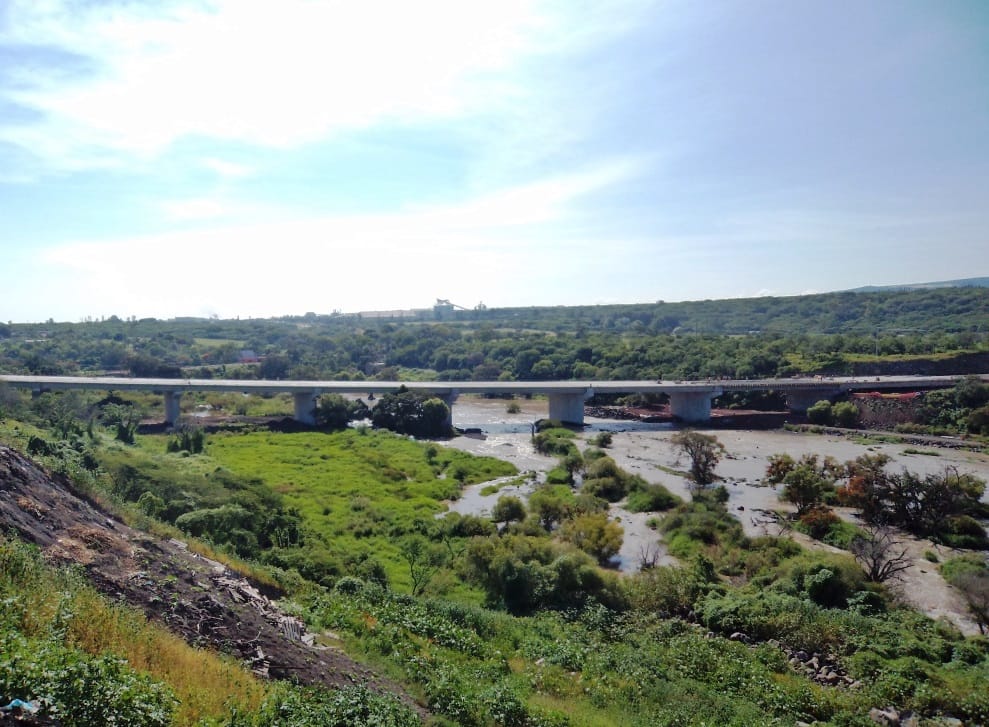
Once inside the airport, their heart raced, and they started to sweat. They repeated a mantra: Everything is going to be fine. Everything is going to be fine.
Still, they couldn’t quash the panic. “I know I have my green card,” they reasoned. “I know I'm a teacher. I've never been arrested. I've never done anything. But in the back of my head, I'm thinking: ‘What if the worst happens?”’
They texted their sister the whole time. I'm OK. We got through security. We're about to board. We're out of the airport.
When she reached her tiny hometown, nestled in the foothills of the Sierra de las Cruces, it was not the same place she fled as a child. Near Toluca, about 40 miles west of Mexico City, she found it louder, poorer and more dangerous than in her memories.
She stood in the house she lived in during her early years. She visited the graves of relatives lost to COVID-19 and senseless violence. She hugged those still living — the cousin she once considered her best friend and the grandmother who hadn’t held her since she left.
And she saw her mother, the woman she accused of abuse in court. They talked at length, allowing her to share feelings she had long suppressed.
“I was finally able to sort of make my peace with her and with everything that she put me through,” Silva Alvarez said.
Sanchez, the psychologist, noted how disorienting an abused person’s homecoming can be. “When you return to a place where trauma happened, it can bring you back to that version of yourself,” she said. “She was seven years old when she left. There may have been moments where she felt like that 7-year-old, frozen in time — maybe when it comes to interactions with her mom, or feeling powerless.”
Silva Alvarez did experience moments of unease, particularly when her mother admitted she didn’t regret losing her to another country. Her life in the United States, her mother said, would have been off limits in Mexico.
“I was hurt,” Silva Alvarez said. “At the end of the day, I'm your child. How could you not regret giving me up?”
But they also understood. Their mother was 17 when she had them. She had no support. She was a minor raising children in an environment rife with poverty and violence.
“Had she not done that, I don't think I would still be alive,” they said.
That thought persisted as Silva Alvarez passed through the village — the rural roads, humble cottages and a cemetery filled with family. It lingered in the house where her relatives share one room, scraping by on her grandmother's Social Security benefits. And it stayed with her when she learned the 13-year-old brother she'd just met had been robbed at gunpoint a month before her arrival. Her other brother, who was 3 when she left, struggles with addiction and has been in and out of rehab, she said.
Silva Alvarez, meanwhile, earned a master’s degree in education in 2023. She is now pursuing a PhD in educational leadership, with the hope of one day becoming a school administrator. In Mexico, she said, these achievements are “something I don't think I would have ever been able to do.”
Daniela Silva Alvarez discusses returning to Mexico for the first time in 20 years. Video by Stella Kalinina for The Fault Line.
Back in Lynwood, Silva Alvarez cherishes the opportunity to fill a role she once feared would elude her without papers: teacher.
At Lynwood High, where she has taught full time since 2023, her approach to education has earned recognition beyond the classroom. Last October, Teach Plus California named her a 2025–26 policy fellow. The organization supports teachers who foster equity for students and selected her from hundreds of applicants for her ability to “combine her passion for education with her passion for advocacy,” said Bryan Monroy, Teach Plus California’s policy manager.
“She’s really demonstrated that she'll go above and beyond, making sure students have the resources they need to succeed — not just academically, but in life,” Monroy said.
Affirming messages appear throughout her classroom. “Trust yourself, the journey you are on, and that things will get better,” one sign states. Students who need time away from the group can sit in a calm-down corner, complete with plush pillows, a small library and cloud-covered wallpaper.
Silva Alvarez may prioritize social and emotional learning, but she’s no pushover. Her students, recently in the middle of a market research project, stayed on task without needing her to hover. And when their attention wandered, even briefly, she snapped students back to task with the same edge as her pointy aquamarine fingernails and laceless combat boots.
On the first day of school, every year, she discusses being undocumented. She reveals this to students because she remembers how alone she felt during Trump's first term when she was their age without legal status.
“What they’re trying to get us back to is being in the shadows,” she said. “But there's so much power in our identities.”
Michelle Zaragoza, a doctoral student at UC Berkeley’s School of Social Welfare who researches the impact of immigration policy on youth, said that kind of transparency matters. “Sharing openly provides hope,” she said. “To have someone who believes in your future means so much.”
When immigration enforcement ramped up, attendance dropped as immigrant parents grew afraid to send children to school. The caution is not unjustified. Zaragoza pointed to the Trump administration's decision to rescind the federal sensitive locations policy, which restricted immigration enforcement at schools, churches and hospitals.
“That was a line we drew,” she said. “That protection is gone. And we see these militarized campaigns for immigration enforcement in neighborhoods. It's visceral, tangible, in your face. It's at an unprecedented level of violence.”
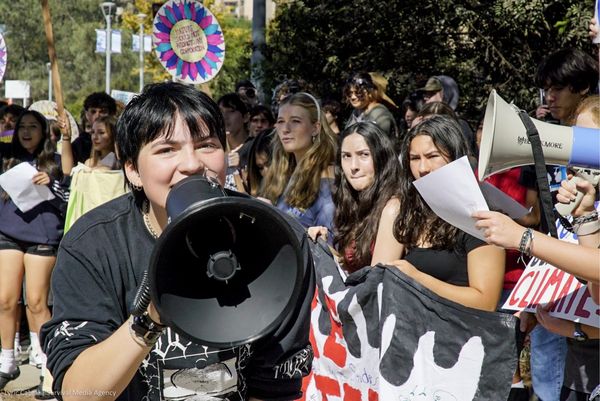
To give students and their families a greater sense of security, Silva Alvarez asked her administration for permission to lead Know Your Rights sessions during the school day. Students open up to her — the teacher young enough to be an older sibling, with nose piercings and pastel highlights in her hair. They’ve told her how scared they are for their immigrant parents. They ask what will happen if ICE comes to campus.
After attending a training with a community group formed in response to the raids, she began helping families understand their rights and how to protect their children.
Monroy said advocacy like this is essential to teaching.
“Students can't leave their lives at the door,” he said. “They don't stop being who they are when the bell rings. If a teacher is not taking the responsibility of ensuring that all parts of a student feel safe and seen, that student is not going to perform academically to their best capabilities.”
Silva Alvarez’s students have individualized education plans outlining the support they’re entitled to — documents often dense and challenging for families to understand.
“The language is sometimes very difficult to translate, even for native speakers,” Monroy said. “Something Daniela does with her students is practice unpacking that document using different translation tools to make sure students can access what it says in order to advocate for themselves.”
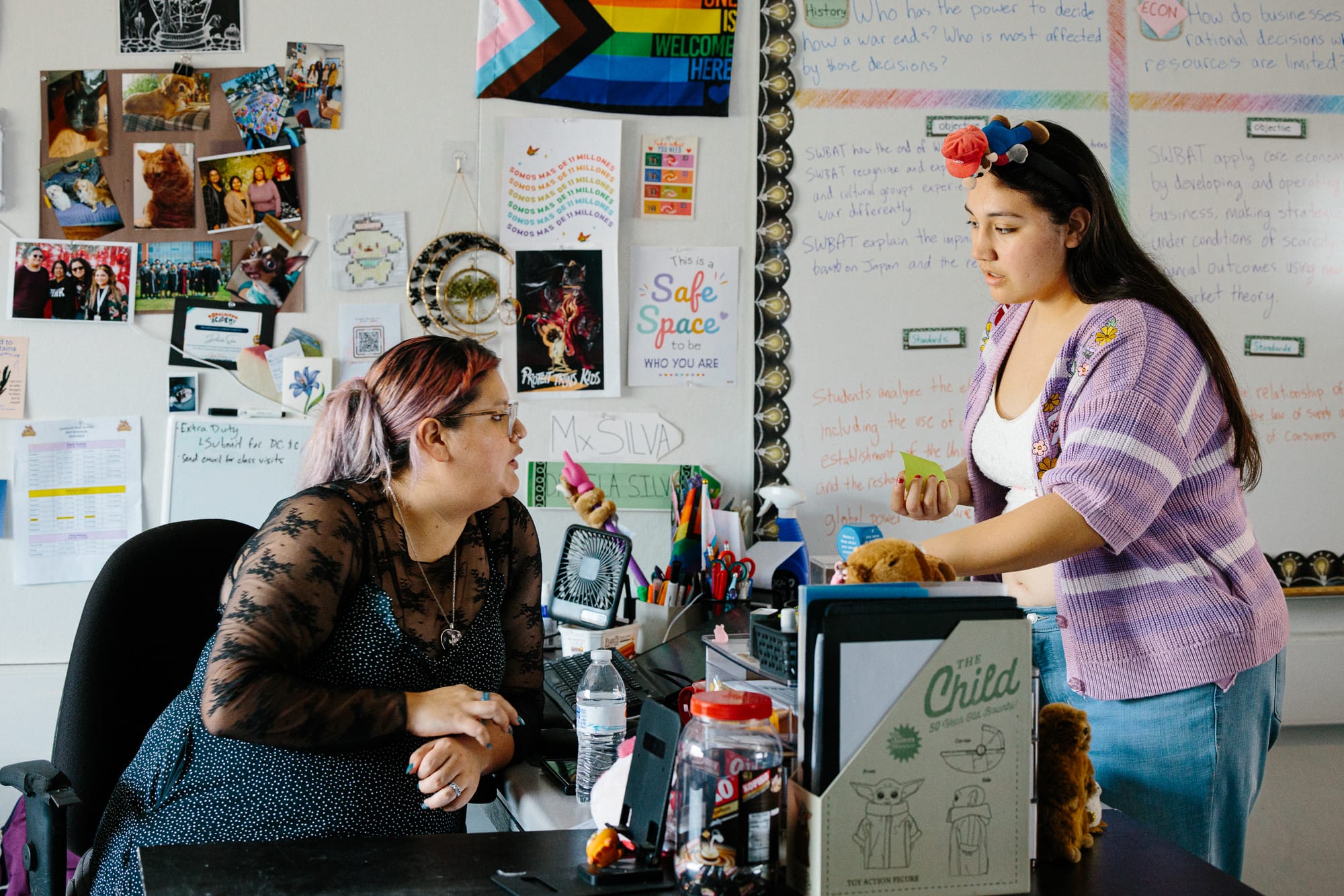
Silva Alvarez continues to organize with United We Dream, the youth-led immigrant justice organization that gave them a community when they felt most lost. They find it comforting to stay in touch with people who understand the immigrant experience.
“I don't think anybody loves the United States as much as an immigrant does,” they said. “Even understanding that the American dream isn't always what it seems, I genuinely am living it.”
As their sister awaits a green card, they try not to dwell on the anger — that litigation and a backlog can derail a young woman's future, that politics and paperwork can deny stability to kids who have already survived abuse.
“I have to stay positive,” she said. “I have to be the support system my sister needs.”
All the while, Silva Alvarez will keep teaching, organizing and tracking relatives’ locations on her phone while planning a future she hopes her sister can share.
“I finally had the opportunity to stand in the house that I grew up in,” she said of Mexico. “I got to see family I hadn't seen in 20 years. I got to say goodbye to a lot of people.”
She paused.
“Next time,” she said, “I'll go with her.”
This article — produced by The Fault Line, an independent California journalism project — is available to republish for free. For republishing inquiries, please contact us.